On Sunday, February 8th, 31-year-old Puerto Rican rapper and singer, Bad Bunny, performed the Super Bowl LX halftime show, the first one in NFL history to be almost entirely in Spanish. The performance ran for about 13 minutes and has since broken the record for the most-watched halftime show with an average of 128.2 million viewers in the United States.
Bad Bunny, formally known as Benito Antonio Martínez Ocasio, rose to fame in the music industry around 2016 and has since taken off as one of the top Latin American artists in the world. Just a week before his Super Bowl performance, he was awarded two Grammys for his album “DeBÍ TiRAR MáS FOToS”: Album of the Year and Best Música Urbana Album. He has made an immense cultural impact on the world of music, and his halftime performance reflected as much.
Bad Bunny’s halftime performance was packed with his top songs, important cultural references, and powerful messages. The show opened in a sugar cane field, which was Puerto Rico’s main source of profit and one of the many reasons the territory became a target of colonization. While performing his hit song, “Tití Me Preguntó,” Bad Bunny walked through the stalks of sugarcane, passing by many culturally significant aspects of Puerto Rican culture: he walks past a piragua vendor, a boxing match, and a table of older men playing dominoes. Right off the bat, he pays tribute to his home country, setting a strong foundation for the rest of the show. Later, he makes other cultural references, such as waving the original Puerto Rican flag colors before it became a U.S. territory, performing on malfunctioning electricity poles to reflect the constant power outages in Puerto Rico, giving classic Brooklyn Puerto Rican social club owner Toñita a special cameo, and many more.
Bad Bunny was not the only halftime performer; he also brought on Lady Gaga and Ricky Martin. Gaga performed a salsa rendition of her 2024 single “Die With a Smile” during a segment set in a wedding scene, which was later confirmed to be a real marriage ceremony. Soon after, fellow Puerto Rican singer Ricky Martin performed Bad Bunny’s “LO QUE LE PASÓ A HAWAii,” a song dedicated as a cry for Puerto Rico’s sovereignty. Martin is known as one of the core Latin American artists in the United States, having paved the way for so many to come after him. For years, he released his music solely in English in order to maintain his success, so to bring him into one of the largest music performances in the United States to perform a song only in Spanish speaks volumes.
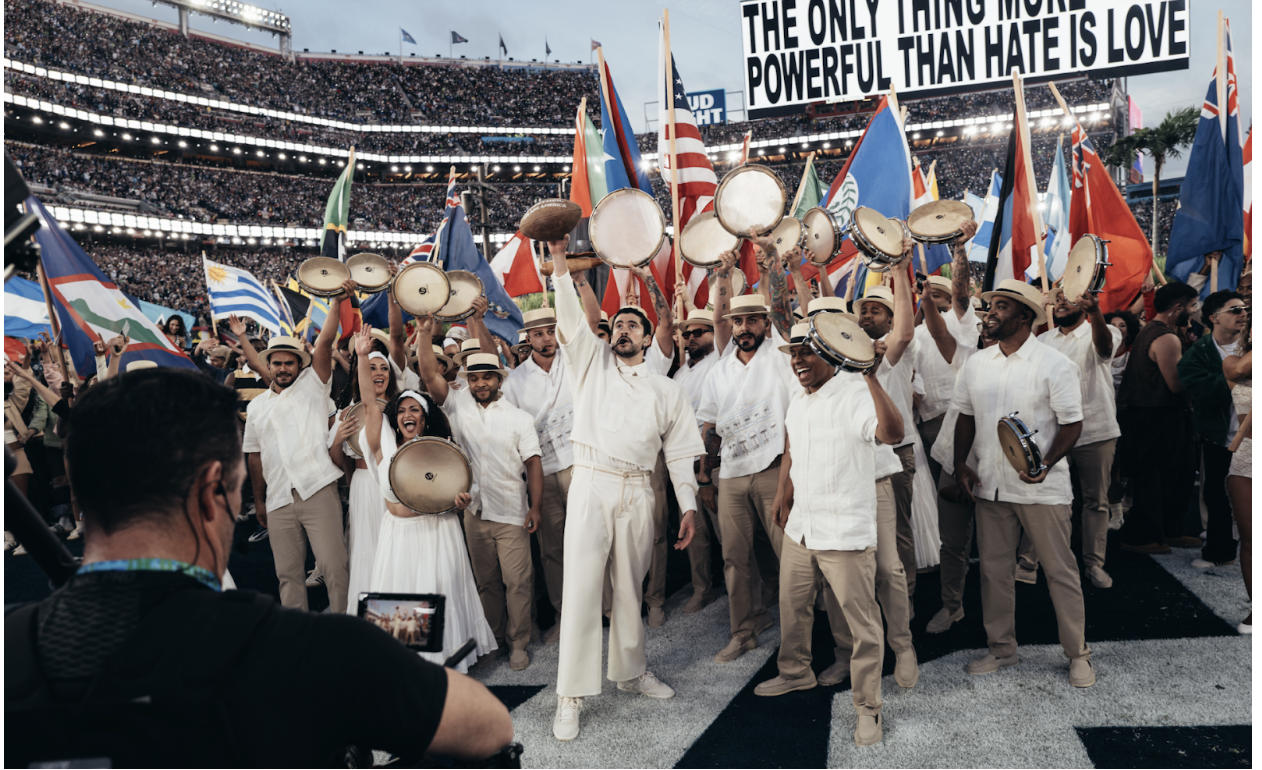
The show ended with a parade of flags from North and South America, where Bad Bunny proudly declared, “God bless America.” He then named every country in both continents with the words “The only thing more powerful than hate is love” projected on a billboard behind him-- a quote he said after accepting his Grammy a week prior. These were all decisions made with full consciousness of the current political climate. With the increase of violent ICE raids and crackdown on immigration laws, especially towards people of Latin American backgrounds, these performance decisions are Bad Bunny’s own way of not only speaking out but bringing unity in a time of division. Specifically, the choice to mention all the countries on the North and South American continents is a breaking of the typical all-American narrative that oftentimes revolves around English-speaking white Americans, rather than the true diverse nature of “America.”
Despite the show’s success, the performance has been subject to a great amount of discourse online, mostly based in politics. Even before the show, many had complained about the prospect of the halftime show being performed solely in Spanish, resulting in the creation of an alternative performance on Turning Point USA, featuring more conservative artists. The show did not perform as well in terms of viewership, but created a further divide, nonetheless. Despite this, Bad Bunny’s record-breaking halftime performance left an immense cultural impact and will most likely keep said reputation throughout Super Bowl history. It was a show of unity, love, and a powerful message that, in the words of Bad Bunny, “Together, we are America.”