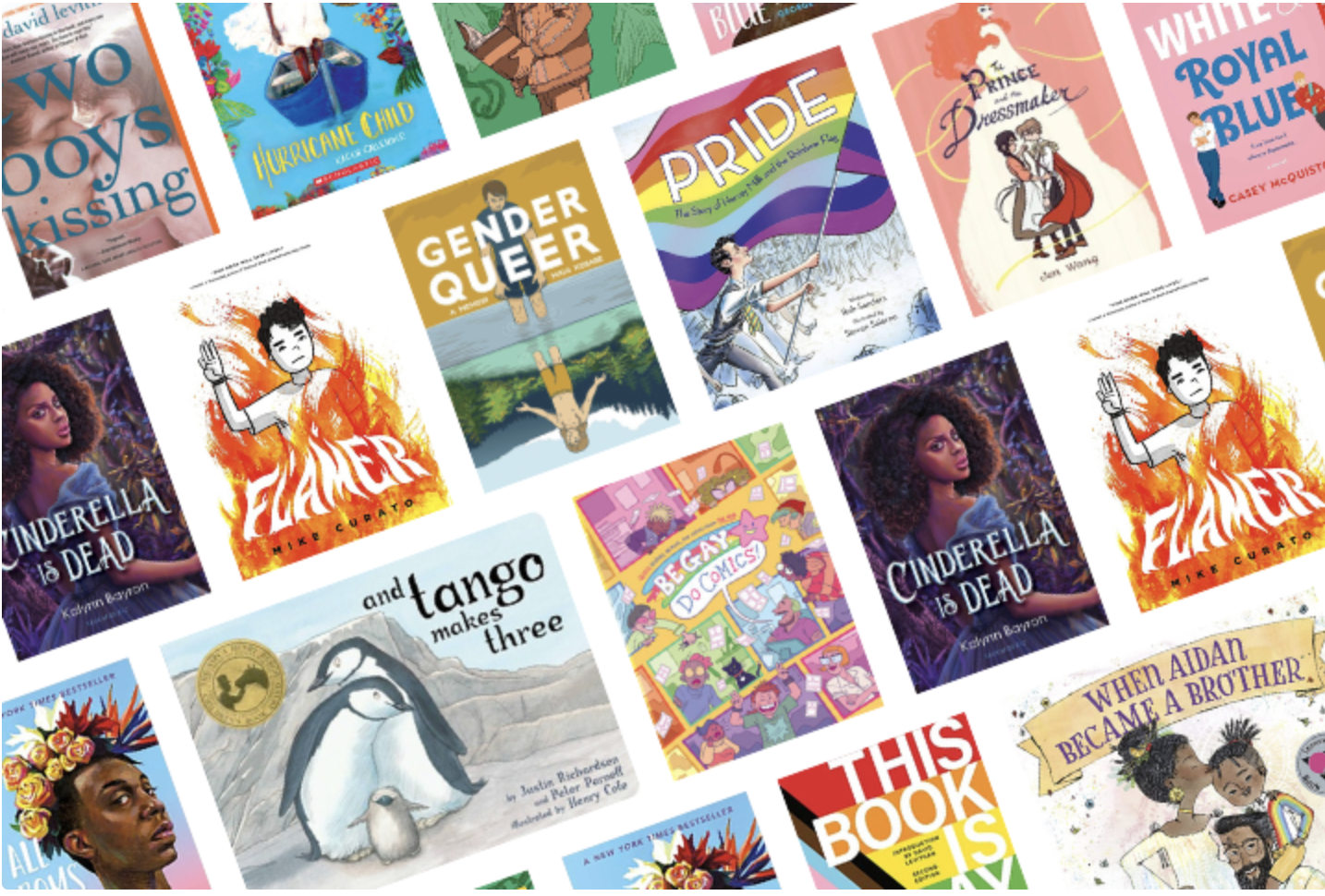
Children across the United States are being barred from reading books—not by their parents or teachers, but by their state governments. In January alone, Katy Independent School District banned over 140 LGBTQIA+ books from school libraries. Language around book bans has been intentionally ambiguous, but PEN America defines the process in clear terms as “...any action taken against a book based on its content and as a result of parent or community challenges, administrative decisions, or in response to direct or threatened action by governmental officials, that leads to a book being either completely removed from availability to students, or where access to a book is restricted or diminished.”
Book bans are, unfortunately, a time-honored tradition in many school districts. In fact, every year, the American Library Association (ALA) hosts a Banned Books Week, which was created in 1982 “...in response to a sudden surge in the number of book challenges in libraries, schools, and bookstores,” according to the ALA website.
ALA hosts discussions, virtual and in-person events, and other resources for community members to protest against book banning in their own communities. Their 2025 Banned Books Week “Censorship Is So 1984. Read for Your Rights” focused on community action in the face of book bans, and their 2026 Banned Books Week is scheduled for October 4-10th.
Community and ALA efforts are not without their challenges, and resisting book banning has only become more difficult in the wake of a new bill introduced by the House of Representatives on February 24th. House Resolution 7661 (HR 7661), also known as the “Stop the Sexualization of Children Act,” details restrictions that would heavily monitor the use of school district funds.
It seeks to amend the Elementary Education Act of 1965, which was implemented by President Lyndon B. Johnson, to adjust funding for public schools and increase standards of learning, especially for lower-income students. It is meant to be reauthorized every 5 years in order to maintain and revise the standards put in place. This act was followed by the Improving America’s Schools Act (1994), the No Child Left Behind Act (2002), and the Every Student Succeeds Act (2015).
These acts seem to be useful in holding accountability in schools, enforcing teacher development, reading and math proficiency, and other educational initiatives to improve schools. However, the House’s new act uses stipulations on district funding to enforce book banning.
HR 7661 uses vague language which states that “No funds under this Act may be used to develop, implement, facilitate, host, or promote any program or activity for, or to provide or promote literature or other materials to, children under the age of 18 that includes sexually oriented material, including any program, activity, literature, or material that exposes such children to nude adults, individuals who are stripping, or lewd or lascivious dancing.”
K-12 schools do not actively supply material that promotes or depicts sexually explicit content. However, House representatives intentionally make these claims to limit the circulation of or outright ban LGBTQIA+ books. Even the title seeks to ban books under the guise of protecting children, when in fact, harmful materials are not provided to children to begin with. They are conservative beliefs dressed up in the flimsy armor of protecting the vulnerable, wielding a sword against the children they vowed to protect.
Far-right Congresswoman Mary E. Miller reveals some nuggets of bigotry within this deliberately cloaked language. She wants to ban any piece of literature that “...involves gender dysphoria or transgenderism.” No posturing here—this is an addendum that does not use the vague language shown above, only revealing Miller’s agenda to remove representation from school libraries. 17 representatives signed the bill, pushing this conservative agenda forward.
The proposed act aims to “fix” a problem that does not exist. Age-appropriate LGBTQIA+ books do not sexualize children—they educate children on different identities and provide much-needed representation to LGBTQIA+ youth. Without access to queer fiction and non-fiction, many students may feel isolated, confused, or afraid to reveal their queer identities to others. In blunt terms, bigotry will ruin their sense of self, removing gateways to acceptance, knowledge, and mental and physical well-being.
Students should have the right to read. By removing LGBTQIA+ books from libraries, the government would restrict intellectual development. Whether it be inside or outside of school, students identify as LGBTQIA+ or will interact with queer people in their personal, professional, and public lives. Our lawmakers are imposing their own beliefs on children who will learn to become close-minded instead of accepting, teaching them that they should be ashamed of their own identities.
There is still time to counteract this bill—HR 7661 has only been introduced, and it has not passed the Senate or been signed into law. The best way to take action is to educate yourself and make your voice heard. To get involved, you can consider a few action items:
Contact your state representative by using the finder on the United States House of Representatives website. For District 20 (Saratoga Springs) in New York State, our representative is Paul Tonko.
Share information with community members.
Keep track of HR 7661 on Congress’s website for updates.
Visit websites like Unite Against Book Bans and The Author’s Guild for resources and tips on outreach.
Book bans are not only an infringement on national rights—they are an infringement on personal freedom and an erasure of diverse perspectives and experiences. Our power lies in speaking up and opposing restrictive legislation.