This year’s student government election season features a wide and diverse field of candidates, with a few positions contested by two or more individuals. More than 15 seats are up for grabs, as both experienced SGA members and newcomers make their case to the student body. Last year’s election saw over 1,000 students cast their votes, representing a notable increase in participation and a sign of growing engagement with student elections. This time, candidates are hoping to build on that momentum, encouraging even greater turnout as students once again have the opportunity to shape their representation.
Speech Night, held on April 1st, drew students, faculty, and administrators to the Wyckoff Center to hear proposed platforms and goals, encouraged by candidates’ posters and Instagram campaigns. Prior to the debate, attendees filled the room to capacity, prompting administrators to place more chairs in the back of the room. Zach Schwann, Director of Leadership Activities, emphasized respectful dialogue and thoughtful engagement and stated clear guidelines discouraging personal attacks or unclear questions.
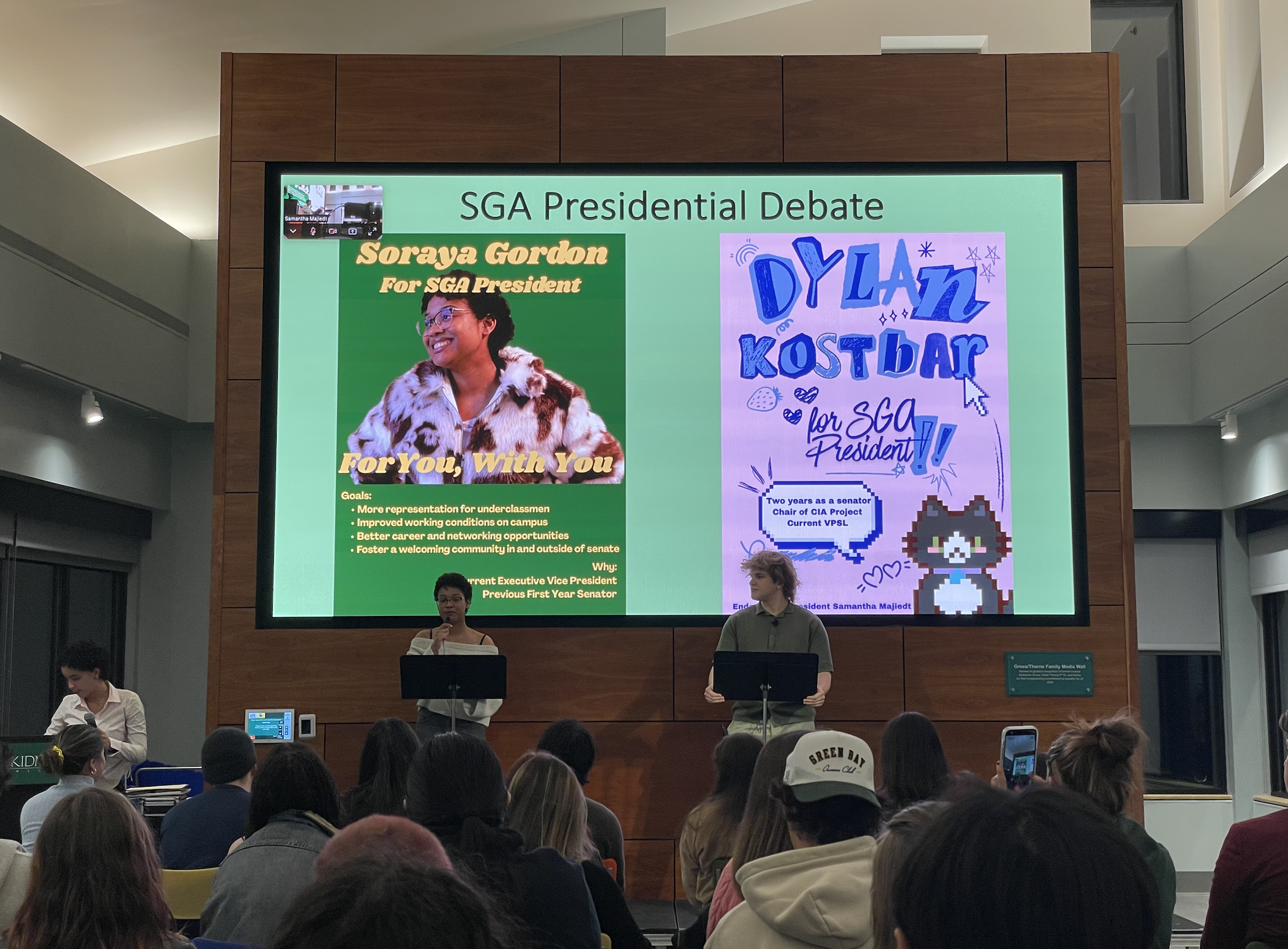
Despite delays due to technical issues, little tension could be felt from the audience and speakers. This year’s candidates for SGA President, Soraya Gordon ‘29 and Dylan Kostbar ‘28, even appeared to play a round of Chopsticks on the podium. Unlike the last two election cycles, the two have run similar campaigns, both promising greater transparency from SGA, stronger student engagement, and improved accessibility on campus.
Gordon centered his campaign on empathy and representation. His campaign account @sorayag4prez features posters explaining his position as a candidate, including student endorsements. A psychology and business double major, he previously served as a First Year Senator and is currently Executive Vice President. He argued that empathy and kindness are a strength in leadership and detailed his identity as a Black, transgender, and queer student to advocate for a more inclusive and welcoming community. He articulated that inclusivity includes reaching out to marginalized groups, improving conditions for student workers, and strengthening connections with Saratoga and Capital Region businesses to expand professional opportunities for juniors and seniors. Throughout the debate, he repeatedly mentioned the importance of listening to students, promoting open dialogue, and ensuring that all perspectives are valued.
Kostbar, an SGA Senator for two years, current Vice President for Student Life, and participant in the Committee on Operations and the IPPC Subcommittee on Student Affairs, focused on experience, collaboration, and institutional accessibility. In an earlier statement to The Skidmore News, he explained that he wants to build an SGA that more fully represents the student body and strengthens its ability to act. As part of this platform, he wants to advocate for the reconsideration of the Committee on Institutional Accessibility (CIA) Project—an initiative that did not pass an SGA vote earlier this spring. Kostbar also featured endorsements from several student organizations on his campaign account, @kostbar4prez. He stressed that no single leader can represent every lived experience, but effective leadership comes from actively seeking out diverse perspectives and working alongside student groups. His proposals included improving SGA’S transparency through better use of social media and meeting summaries and expanding access to campus resources such as the band trailer and dining accommodations. During the debate, however, he was cut off several times as moderators enforced strict time limits for fairness, preventing him from fully completing or clarifying his response.
During the student question portion, both candidates were asked how they would support student-athletes. Gordon noted that sometimes “athletes feel a certain hate on this campus” and spoke of initiatives to make them feel welcomed and supported. He advocated for increased promotion of athletic events and stronger academic support systems for student-athletes. Kostbar used his experience with athletic committees to speak about cross-campus collaboration and boosting visibility at sports events. Many times, both candidates stated that they agreed with the others’ statements.
Notably, in a separate question about allocating school resources, current SGA President Samantha Majiedt reminded candidates not to speak about confidential funding decisions and information. Gordon talked about adding more trash cans across campus and increasing funding for events to address campus loneliness. Kostbar, on the other hand, proposed investing in more public art on the outward facades of campus buildings as a way to showcase student talent and beautify spaces.
In his closing statement, Gordon emphasized that being a freshman shouldn’t be a limitation but rather an opportunity to bring fresh perspectives and energy to the role. As a sophomore, he would also have more time to dedicate to student government. Kostbar emotionally spoke about his growth within SGA and the relationships formed, proudly holding up a notebook that was gifted to him from a friend who has been a great support. He said, “I want to be a peer, friend, source of information, gym bro, bandmate—whatever you need me to be.”
Following the debate, Kostbar posted a video in which he explained that despite “thorough preparation for last night’s debate,” he felt he could have conveyed many points better. He also shared that he is neurodivergent and that this can manifest as anxiety in large crowds and on stage, which may have contributed to his communication. “My difficulties with crowds and stages have never, and will never, prevent me from being the kind of leader Skidmore needs,” he concluded.
The next debate featured the Vice President for Financial Affairs (VPFA) candidates – Raahim Latif ‘28, Austin Zhang ‘29, and Jonathan Lipman ‘27. Each centered their campaigns on transparency and accessibility in regards to student government funding, although their approaches differed. Latif underscored his experience as Freshman Senator, Sophomore Class President, and on the Budget and Finance Committee, the Committee on Institutional Diversity, and the Subcommittee on ADA. He argued that his familiarity with bylaws and club needs would allow him to effectively support students. Zhang focused on structural reform, saying that he’s seen where the system breaks down and how confusing policies stop requests before they can continue. He added that funding at Skidmore is about navigating systems to bring student ideas to life and positioned himself as a candidate who could do so, suggesting clearer guidelines and standardized feedback to help clubs navigate funding and budget requests. Lipman talked about his experience reviewing over 90 club budgets, thrice helping to allocate nearly $1 million in annual budgeting, and participating in the search committee to hire a new SGA accountant. He proposed initiatives like treasurer mentorship, open budget meetings, and small descriptions of Senate meetings. Attempting to establish himself as a candidate with a fresh perspective, he also pointedly voiced his dislike for Claude AI and his opposition to using it for summarizing Senate sessions.
When asked how they would explain complex financial jargon, Zhang said he would simplify concepts to students through clear, distributed examples. Lipman proposed creating a terminology glossary, and Latif gave a live explanation of the distinction between budget and supplemental requests.
A question about compensation for student government representatives also showcased different approaches. Zhang opposed the idea, saying that he isn’t participating in student government to be paid but rather because he has a “passion for serving the people,” and instead wanted to fundraise for student clubs and pay others. Zhang has significant experience in fundraising, a point that he also made very clear during his bid for First Year Senator in the fall. Lipman opposed as well, asking the audience, “Do you want your tuition money to go to clubs and activities or to paying individuals such as myself?” In response, opposing shouts of “individuals!” and “clubs!” were heard. Latif initially stated that he had been against compensation in the past but was cut off before fully explaining. He later clarified that existing bylaws already allow for compensation when financially possible.
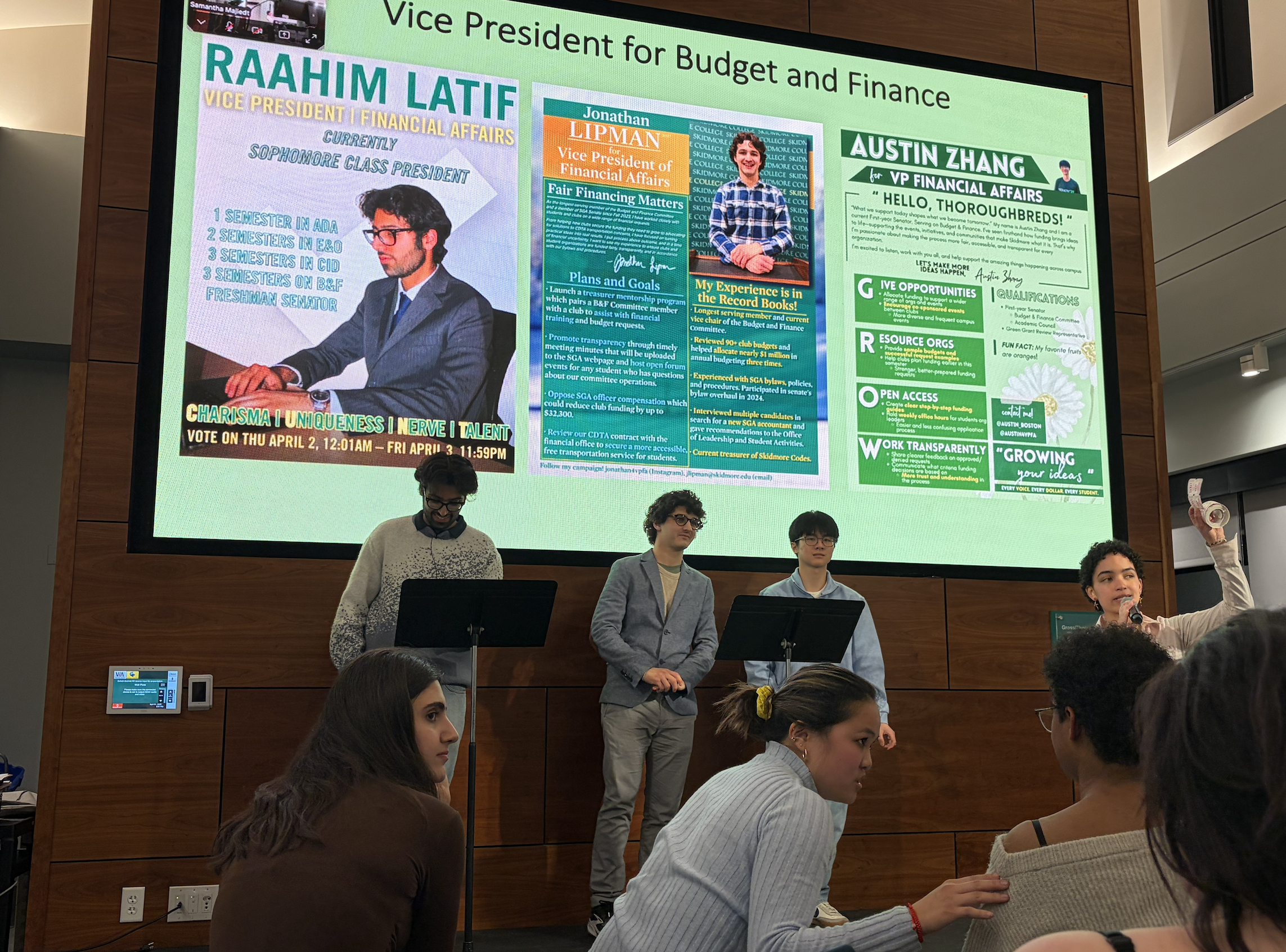
(Left to right) Candidates for VP of Financial Affairs, Raahim Latif ‘28, Jonathan Lipman ‘27, and Austin Zhang ‘29. Image courtesy of Sruti Ramaswamy ‘26.
There were some surprising moments during the VPFA debate. Latif was often cut off, having exceeded his time to speak. In response to a question about building positive relationships with administration, he drew attention with a remark about having “once blackmailed Marc C. Conner” but then said, “I can talk to administrators in a way that’s respectful.” Answering the same question, Lipman passionately argued that college administration and staff aim to maintain image and that he would treat staff with mutual respect to “ensure the SGA image is not tainted or ruined.”
The third debate was between Bradley Kadets ‘27, current Chief Judicial Board Officer, and Bryce Terry ‘29, current First Year Senator, for Executive Vice President (EVP). The two presented contrasting but also overlapping visions for the role, focusing on different ways to do so. In an earlier statement to The Skidmore News, Kadets said he is seeking the role because of its need for strong technical knowledge of SGA operations. Citing his previous leadership experiences as a Senator and Vice President for Financial Affairs, he believes he is qualified for the seat. He also aims to publish draft resolutions to allow for students’ feedback before votes take place. Kadets is the first candidate this season to have served in all three branches of SGA, exclaiming during his speech that “when you love something, you never work a day in your life.” Seemingly addressing a widespread concern that SGA members have raised this year, he added that his primary goal is to improve transparency by ensuring Senate meeting minutes are posted on time each week and making sure that everyone is held accountable for following rules.
On the other hand, Terry centered his speech on a community, harkening back to the motto “Lift While You Climb” that he used in his candidacy for First Year Senator in the fall. Collaboration, inclusivity, and personal growth were the focal points of his speech. He also mentioned the importance of making meeting minutes organized and accessible, but his responses zeroed in on leadership and creating a supportive campus environment. Talking about his own experience as a student-athlete, Terry emphasized that while he plays sports at Skidmore, it does not solely define who he is as a person or candidate. “I’m a kind person who leads with love,” he told one student, “whether sports are part of that conversation or not.”
The last debate featured Evvy Shoemaker ‘28 and Abigail Lewis ‘27, vying for Vice President of Engagement and Outreach. Both spoke of the importance of accessibility and communication in their campaigns.
In a statement to The Skidmore News, Shoemaker said they are running to ensure all students better understand how and why SGA operates. They emphasized making SGA more accessible and community friendly, including publishing easy-to-understand versions of the bylaws, constitution, and resolutions. They cited their experience as a professional social media assistant manager prior to college, being a project leader for the CIA initiative, and their openness to collaboration rather than doing everything individually. In a personal moment, they also stated that they’re committed to making SGA a space that doesn’t feel unsafe to enter, admitting that they’ve experienced many moments where they don’t feel welcome. “Lots of SGA students feel a sense of superiority because they get to access administrators more, and I want to change that,” they declared.
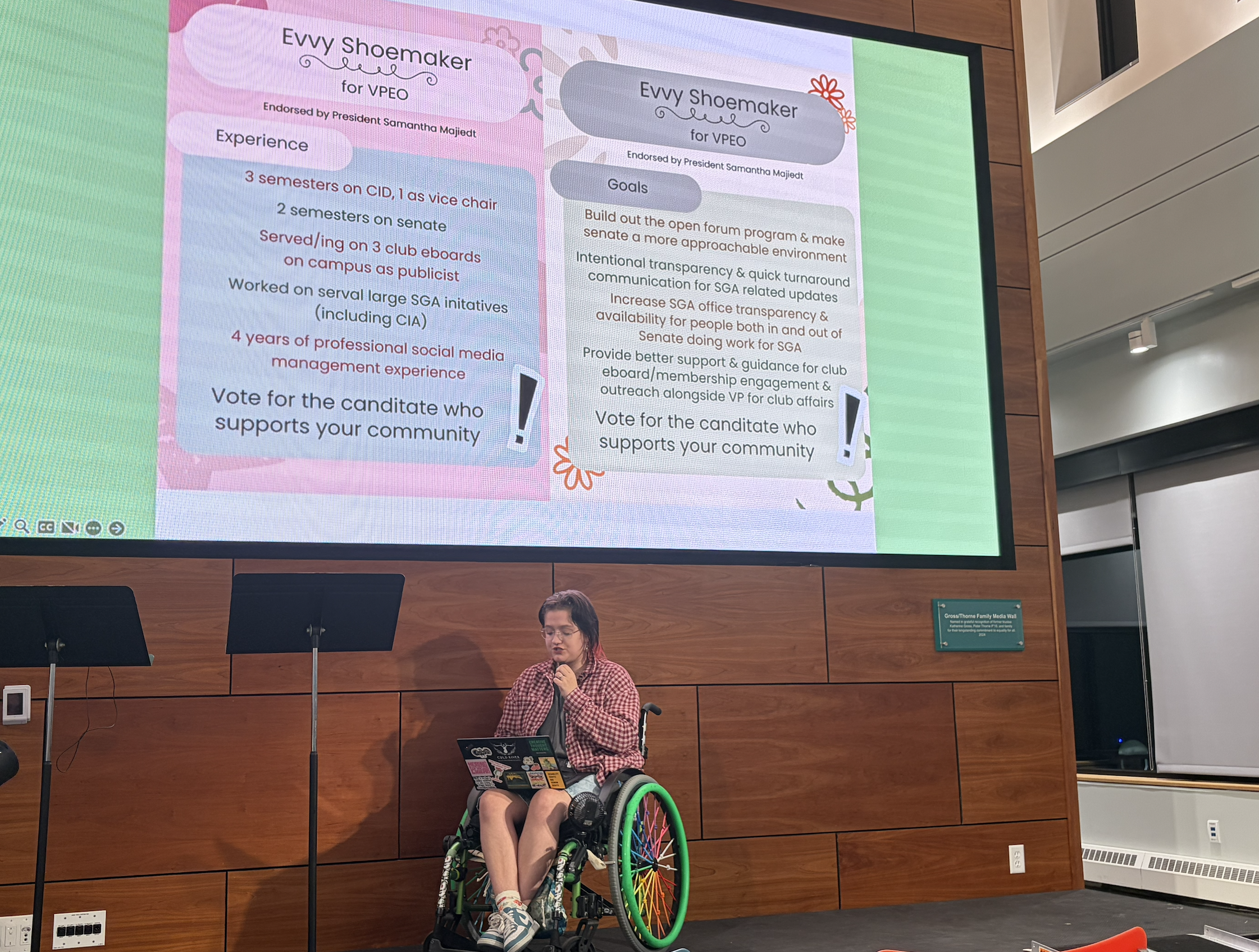
Candidate for VP of Engagement and Outreach, Evvy Shoemaker ‘28. Image courtesy of Sruti Ramaswamy ‘26.
In lieu of an in-person speech, Lewis, who is currently studying abroad in Copenhagen, Denmark, sent in a video speech. She stressed how important it is to educate students about SGA’s role, proposing clearer communication about resources, making SGA more approachable and understandable for all students, and supporting opportunities for student involvement. She attributed her initial involvement with SGA to advocating for Late Night to be moved back to Spa in 2024; this presented an empowering avenue for direct change. She noted her multiple semesters managing SGA’s Instagram, serving as Vice Chair, and working in Skidmore’s marketing department, as well as more than eight years in content creation. Lewis’s speech was paused by moderators due to the three-minute time constraint, but audience members asked to contact Lewis about getting access to the whole video.
Other candidates who sent in videos included Paul Ziek ‘27, running for Vice President of Student Life, and Zara Uju Nwosu ‘27, who is running for Vice President of Institutional Diversity. Both are running unopposed. Instead of listing accomplishments and proposed initiatives, Ziek opted for a short video announcing his campaign with the tagline “Don’t sleep, vote Zeke.” Nwosu, on the other hand, chose the more traditional route, mentioning her role in raising money to help the Frederick Allen Lodge in Saratoga Springs, calling for minority students to be seen as priorities on campus, and advocating for a foundation of respect and inclusiveness for all.
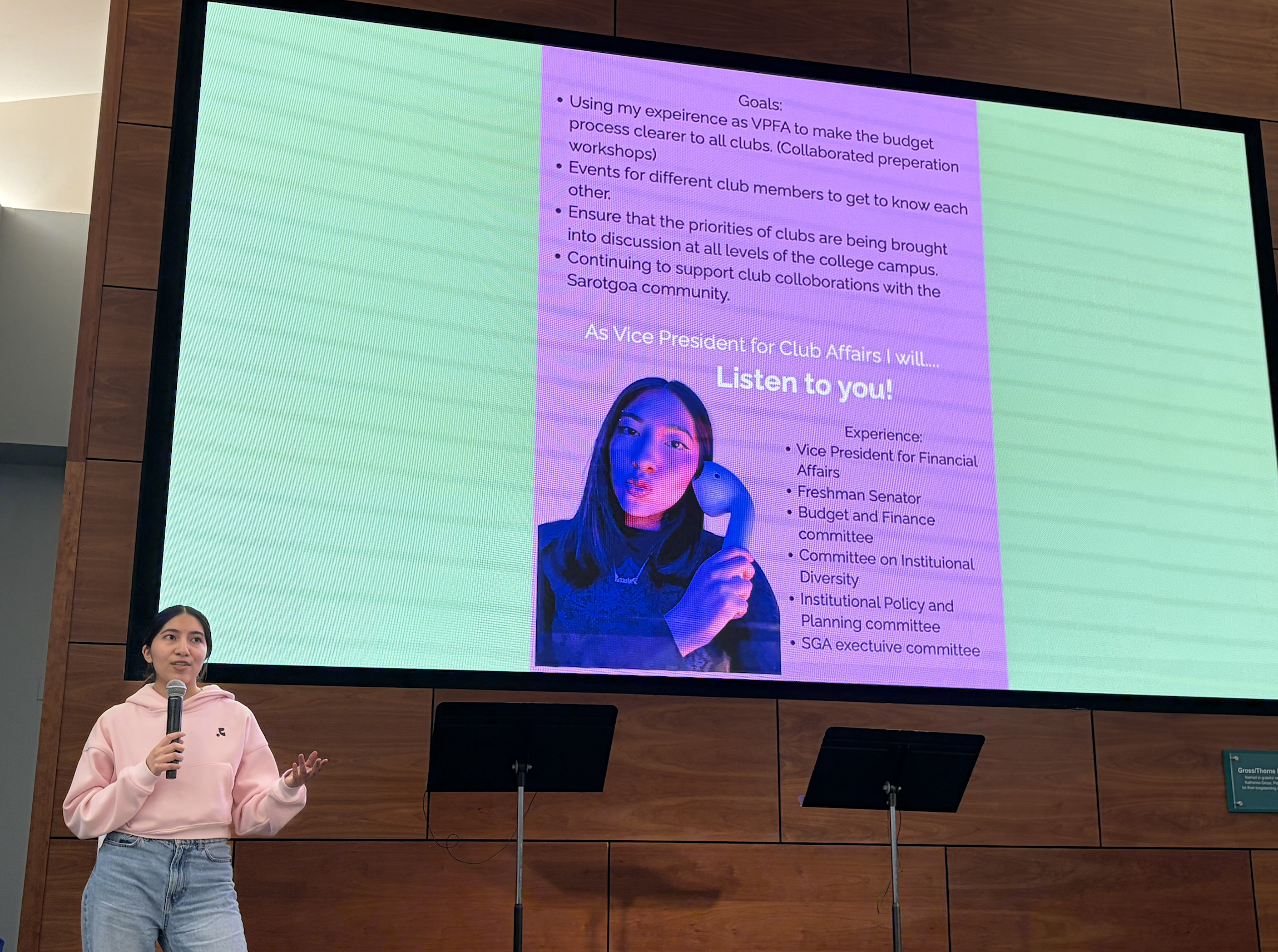
Candidate for VP of Club Affairs, Claudette Castillo ‘28, making her speech. Image courtesy of Sruti Ramaswamy ‘26.
Additionally, two students are running for Junior Senator: Chloe Filipo ‘28 and Natalie Koegler ‘28. In her statement to The Skidmore News, Filipo explained that she’s running for the seat because, based on experience at Senate and committee meetings, she wants to improve engagement between SGA and the student body, including the promotion of improved accessibility services around campus.
After nearly three and a half hours of speeches, voting opened on SkidSync on April 2nd and will remain open until 11:59 PM on April 3rd, leaving final decisions in the hands of the student body.
The following candidates are running unopposed and can be voted for on SkidSync.
Katherine Sterling ‘27 – Vice President for Academic Affairs
Paul Ziek ‘27 – Vice President for Student Life
Claudette Castillo ‘28 – Vice President for Club Affairs
Zara Uju Nwosu ‘27 – Vice President for Institutional Diversity
Nila Rothman ‘27 – Student Events Council Chair
Jay Blechman ‘29 – Student Events Council Vice Chair
Audrey Jensen ‘29 – Student Events Council Treasurer
Jocelyn Crespo Hernandez ‘29 – Sophomore Class President
Leo Thomson ‘28 – Junior Class President
Hayden Kokas ‘27 – Senior Senator
Hui Zheng ‘27 – Senior Senator
Nana Kwame Minkah ‘26 – Senior Class President