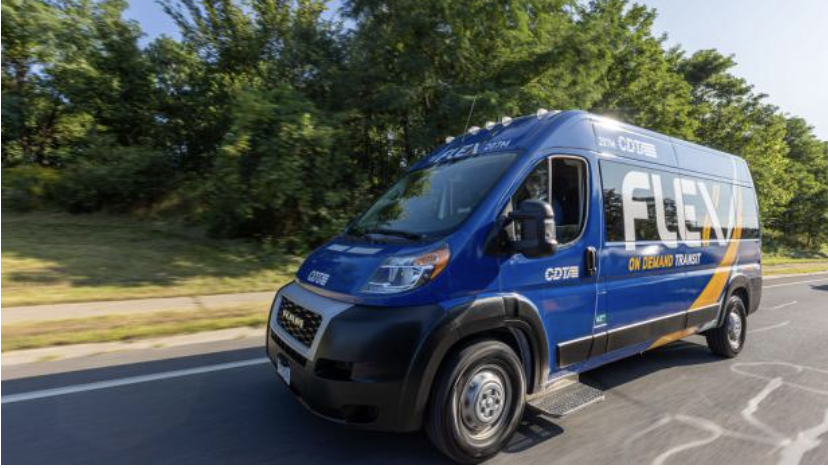
On November 30th, 2025, the Capital Region Transportation Authority limited Route 452, Skidmore’s main bus line, to nighttime stops on Thursday, Friday, and Saturday nights. After the announcement of this decision, the CDTA offered a new option: FLEX. For two months, FLEX has been the primary form of transportation of Skidmore College to Saratoga Springs. FLEX, a swipe-to-pay minibus that accepts Skidmore ID cards in lieu of payment, charges the standard bus fare of $1.50. Despite the CDTA’s optimism that FLEX would reduce waiting times and increase ridership, the implementation of the new system has resulted in several accessibility concerns and safety risks.
Firstly, the requirements to order a FLEX limit their accessibility. To book a FLEX, individuals must download an app as opposed to simply standing at the bus stop at the scheduled time. I, and others, have repeatedly chosen to walk instead of trifling with the app, where the option to order a FLEX is buried beneath information about locating bus lines. This is a small, but frequently espoused complaint by Skidmore students, and one that should not go unobserved.
Then, of course, there is the issue of capacity. FLEX vans are notably smaller and more cramped than the decommissioned Route 452 buses. Unlike Route 452, which had permitted large groups to travel into town together, multiple FLEX buses must be ordered to transport larger parties. FLEX vans seat an average of 8 passengers, while the bus seats between 35 and 40 riders. This is troublesome, as the habitual lateness of the FLEX bus can inconvenience the group through differences in drop-off time.
FLEX, furthermore, has a limited service area. Students cannot reach Wilton Mall, a popular stop on Route 452’s path, requiring them to book ride-hailing services with steep prices. Wilton Mall risks losing valuable customers as students weigh the added expenses to in-person shopping in comparison to e-commerce. But the true problem lies in FLEX’s operating hours, which pose a notable conflict for Skidmore students as the weather worsens.
Winters in Saratoga Springs are bitter things. The day begins to wane at four in the afternoon. It is pitch-black by dinnertime. The sidewalks slick with black ice, there is rarely enough salt to safely tread on them. On the Skidmore campus, though pains are taken to maintain our walking paths, New York’s torrid storms are impervious to the valiant efforts of the Skidmore snowplows. And the chill is something terrible. It bores down through the skin to the bone. The wind burns exposed flesh like white fire. Every footstep feels heavier and heavier. Your eyelids begin to droop, and you are exhausted after only a quarter-hour of exposure. All this to say that the walk from Skidmore to the city is not without adversity. With an estimated 42 dead across the United States from the recent freeze, walking in these conditions is unquestionably hazardous. FLEX’s hours are limited, running from 6 AM to 9 PM on weekdays and 8 AM to 7 PM on Sunday, while Route 452 ran as early as 4 AM on Saturdays. Most students will elect to walk the cold mile between the college and the city instead of paying to take an Uber or similar pay-to-use transportation services. This places many individuals at a safety risk.
The safety threat posed by FLEX’s limited hours is not one that is exclusive to Skidmore students, but to the many residents of Saratoga Springs who used the city bus and who are now without a public transit option. This icy climate is one that many are unprepared for, and many do not understand the severity of the consequences of extended exposure. As the temperate autumn sun slipped away, the heating of the city bus kept Skidmore students – and Saratoga Springs residents – warm on their late trips to town. Now, in the pit of winter, with inadequate access to public transportation, Saratoga Springs residents are expected to hazard their health or pay sums exorbitant in comparison to the bus fare.
We have a tendency to disregard most things that do not affect us. It is easy to be indifferent when we are unaffected by consequence. When Skidmore’s access to the city bus was cut off, I felt no strong convictions. I had two strong legs and the drive to get where I wanted to be. I had snow boots. I had the down jacket and the gloves and the wool hat. It would be a twenty-minute walk, twenty-five if the sidewalks had not been cleared and salted, as they often aren’t. If I did not have the constitution to weather the cold, I had enough money to book a ride. But many others do not possess these comforts, and when we think of all the things that we do have, we must never neglect to consider those who are in want of what we take for granted. With Saratoga Springs’ enduring homeless crisis, worsened by its criminalization, the end of Route 452 was a devastating blow. The ice-slickened sidewalks, the dark, the cold; all these factors combine to make an atmosphere of absolute hardship for residents of our city. The obsoletion of Route 452 is but a small symbol of our inhospitality to the disabled, the elderly, and the poor. Inhospitality makes itself interchangeable with cruelty when safety is jeopardized. And, with the bitter cold, there is certain danger. FLEX’s limited hours are a damning fault. They are a fault that betrays the inhumanity of policy that prioritizes efficiency over health.