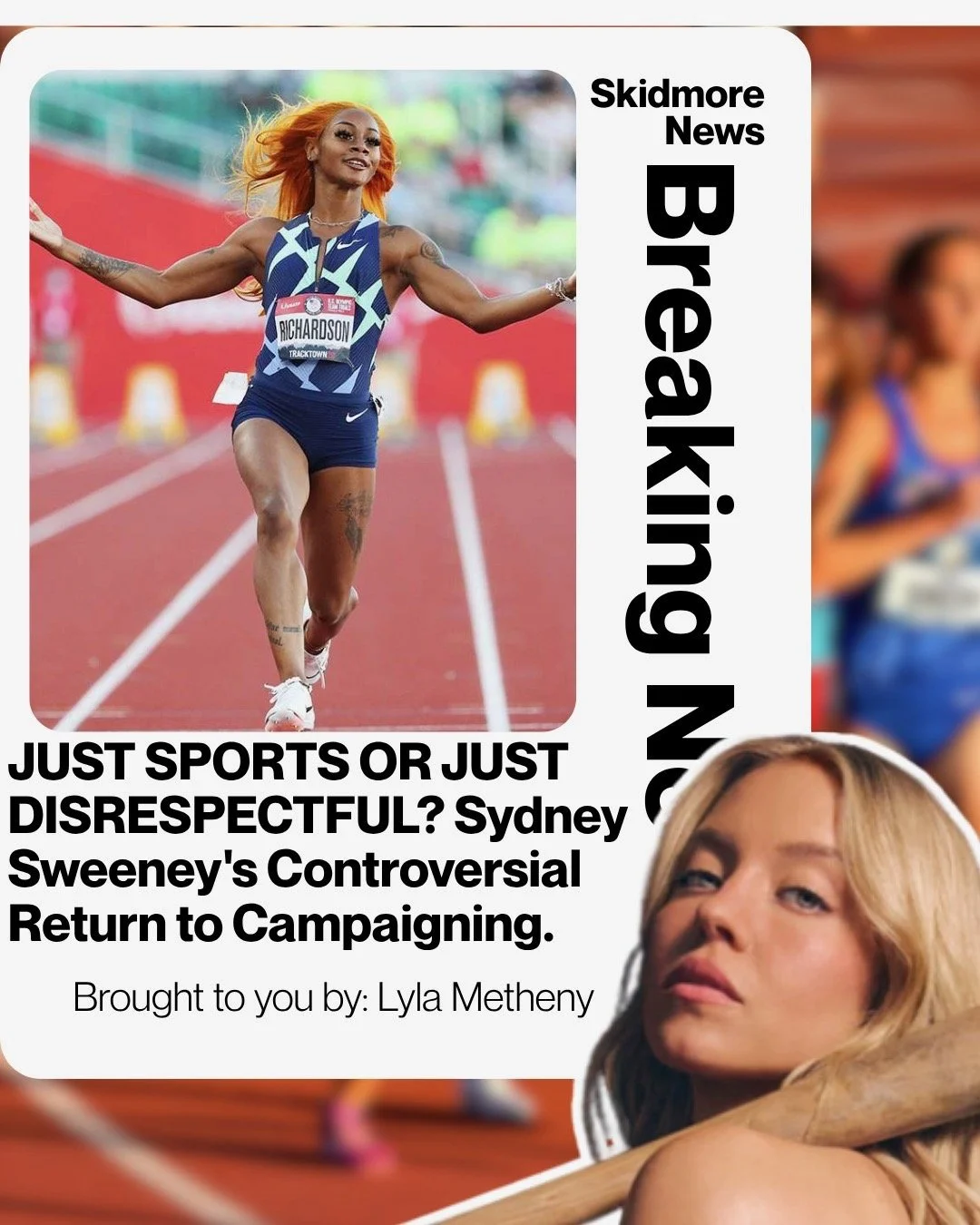
“Just Sports” was the tagline of the ad for the online sports betting platform Novig released on September 9th, but its content shifted viewers’ focus from the marketing of sports betting to the ambassador of the advertisement.
Sydney Sweeney, well known for her roles as Cassie Howard in Euphoria (2019-2026) and Olivia Mossbacher in The White Lotus (2021), poses provocatively with different sports equipment and apparel covering her body, which was otherwise exposed throughout the ad. She speaks in a sultry tone, repeating the word “sports” while the equipment she appears with changes routinely – from basketball hoops to tennis rackets to hockey sticks – to reveal the different sports that Novig users are able to bet on using the service.
“Think you know sports? Prove it,” Sweeney challenges at the beginning of the advertisement.
Novig, in which Sweeney is an equity holder, launched in 2021. It utilizes peer-to-peer trading in its programming and allows users to make real cash withdrawals from their winnings.
The 60-second immediately gained mass media attention across Novig’s Instagram and X social media pages and has surpassed 50 million views since its initial release. Sweeney’s look in this particular advertisement raised the conversation surrounding the media’s portrayal of female athletes’ bodies, which is frequently focused on physical appearance rather than objective skill.
“The concept [of the ad] is simple: cut through the noise and put the focus entirely on sports,” Sweeney stated in a press release with Novig. It stated that the campaign “brings that idea to life with confidence, humor, and a playful edge.”
In the minds of many viewers, including professional female athletes, the focus of the ad was not a celebration of the sports that Novig users could bet upon, but rather a depiction of the sexualization that female athletes face.
“I can’t explain how infuriated I feel when I watch this [ad],” Ariarne Titmus, a four-time Olympic swimming gold medalist, wrote on Instagram. “How do we live in a world where monetizing a woman’s body and sexualizing women’s sport is still a thing?”
In an additional Instagram statement regarding the ad’s release, former U.S. gymnast Gracie Kramer wrote, “I’ve spent my entire life competing in a sport where female athletes have been oversexualized, reduced to our bodies, and forced to fight to be taken seriously for what we can actually do.”
She also posted multiple stories on her social media pages depicting herself in training, with the caption, “This is what a woman in sports looks like.”
In response to Kramer’s movement, other professional female athletes, including British sprinter Amy Hunt and Australian swimmer Lani Pallister, have posted training and competition footage of themselves while writing the same sentiment. Their directed actions sought to remind their viewers and followers that women's bodies are far more powerful than was depicted in Novig’s advertisement, which seemed to suggest that sexualization – and therefore profit – was more notable than the credible athletes who dedicate themselves to their craft.
In addition to the response from female athletes, experts on the topic believe that the Novig ad was made not with the primary goal of being for promotional purposes, but rather with the intention to circulate widely on social media platforms.
In an interview for the Northeastern Global News, Stephen Warren, an associate teaching professor of communications at Northeastern University, mused that Novig’s primary goals for releasing this particular advertisement were solely to gain mass media attention and inflict sexualization. He noted that the ad does not appear widely on billboards or in print, but receives attention mostly sourced from social media users.
Because Sweeney herself is not an athlete, he argued that her action of effectively profiting from selling the footage of her body was done with the intent of sticking in viewers’ minds. He also explained that Novig could have selected legitimate female athletes to be featured in their advertisement instead of Sweeney, playing their sport while in uniform.
“Both of those would relate a lot more to sports betting than a naked blonde bombshell,” he remarked.
The choice to cast Sweeney for the advertisement, a person who is not known for athletics, also reflected a broader misconception that women’s appearances are what they must rely on in order to achieve success.
Neither Novig nor Sweeney’s publicist immediately responded to backlash following the ad’s release. On September 14th, Sweeney posted to her own Instagram account, featuring pictures of her taken from the advertisement and placed next to pictures of other celebrities posing nude for ESPN’s annual edition of “The Body Issue,” which included Jason Kelce and Serena Williams.
The intention of “The Body Issue,” per ESPN, is to celebrate and empower the human athletic form, something that many Internet users did not consider the Novig advertisement to be condoning.
The result of this ad is not the first time that Sweeney has received criticism for participating in a campaign. In 2025, she collaborated with American Eagle in a series of advertisements for jeans, wearing a trendy all-denim outfit. The tagline of one ad, featured at the very end, read “Sydney Sweeney has great jeans,” which viewers understood to have a double meaning, meant to praise the actress’s biological genes.
“See what I did there?” Sweeney asked the camera playfully after the tagline was narrated.
The response to that particular advertisement was largely divided among internet users. Reactions to the content ranged from outrage at the thought of the actress’s white skin and blonde hair being the topic of the ad, while others did not consider it to have had an offensive intention.
Sofie Fella, a Chinese-German rugby player, called Novig’s ad “disrespectful to every female athlete in the world.” She explained that female athletes can serve as role models for young girls because they are able to “untangle” the stereotypes surrounding beauty and femininity, simultaneously providing inspiration and reassurance for girls around the world.
Novig CEO Jacob Fortinsky stated on September 15th that Sweeney was “driving” much of the messaging and creative visuals depicted in the advertisement.
He added, “We’re hugely supportive of women’s sports.”
Novig officials reportedly considered the amount of media engagement with the advertisement to outweigh any backlash that the ad received, which was plentiful. While the advertisement did benefit Novig’s wealth, as well as Sweeney’s, the lack of empowerment for women included in the message was apparent, for it reduced the concept of a female athlete to her physical appearance and her ability to profit from it, disregarding her acquired skill set.
Despite the criticism of the ad and Novig itself, Gracie Kramer had an additional message of empowerment for her followers. “This is so much bigger than a moment or a trend,” she wrote on Instagram. “It’s about inspiring real change in the way women are seen, valued, and represented and reminding the next generation of powerful girls that there is no limit to who they can become.”