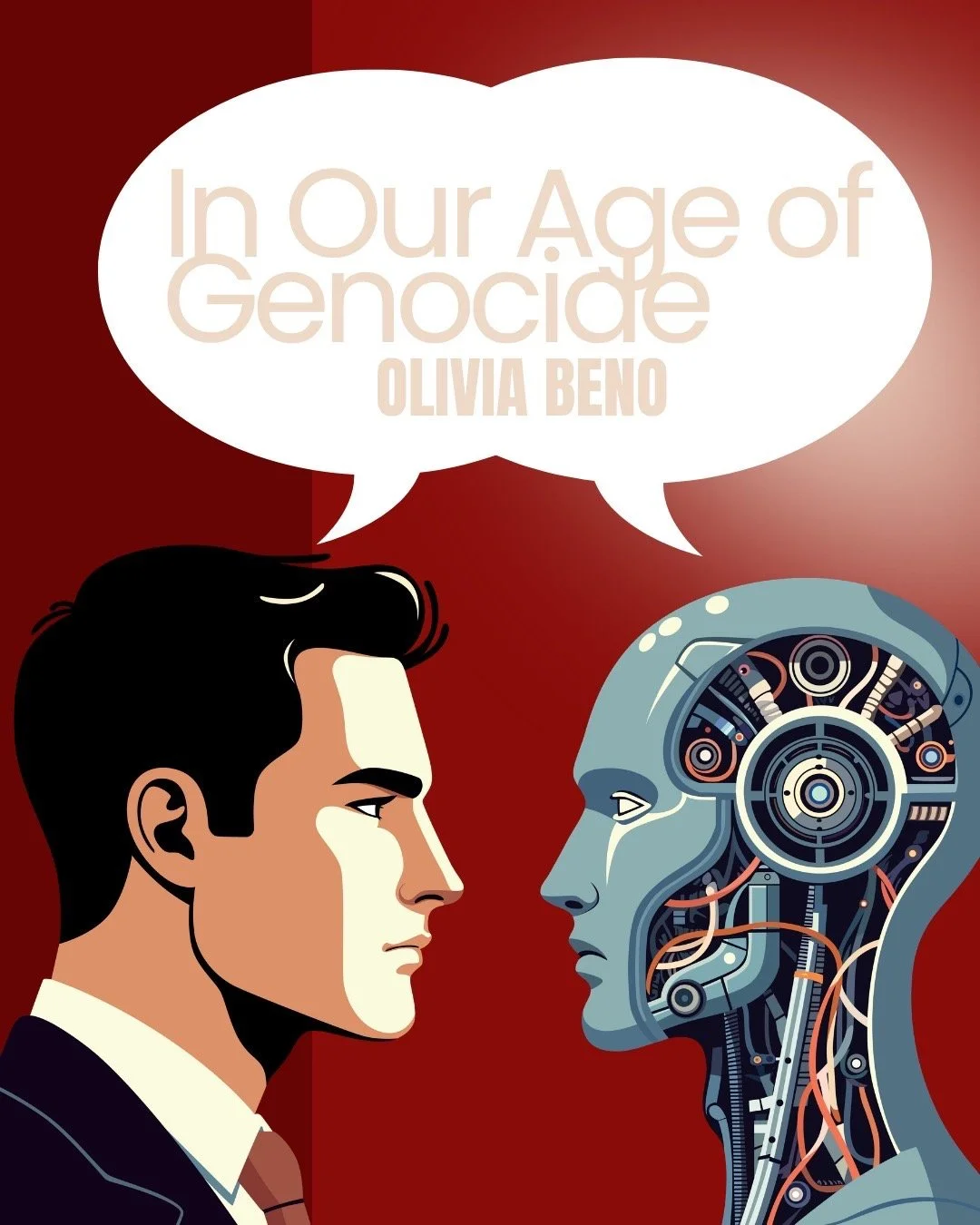
There is an art in dissecting a genocide.
It involves the composition of long lists of possible instigators, the identification of the breaking point, the acquiescence that one cannot determine the precise moment in time that produced the now-certain result. To perform an autopsy, the coroner must distance himself from the body; the victim’s human identity must remain untouched by the emotions of the examiner so that cause of death may be accurately reported. Dissection of a genocide requires the same separation.
But we can no longer be separated from death in this age of genocide. The internet brings us closer to it than ever. We watch the autopsies of mass deaths as they occur online, and we make believe that they belong to a different class of man, a class that is meant to die, a class that has no life beyond their broadcast expiration. We are as detached as a medical examiner. Death is, and must be, transformed into a lesson on living. It is, and must be, made a lie. That is the only way that our uncomprehending minds can reconcile inexistence. And technology not only preserves this pretense but encourages it.
For the blunting of the senses, technology has become an indispensable invention. It is the greatest hoarder of artifacts, the most impressive collector of numbers and words. One simple search, and our discomfort is pacified by its suggested infinite and objective wisdom. Perhaps this is why the development of artificial intelligence is so appealing; we can sublimate a fear of death with the bombardment of its artifacts. Generative intelligence permits us to interact with death with no repercussions at all, for there is no burden of contemplation when the consequence is not immediate. With a screen between ourselves and the suffering of other bodies, we may as well be playing God. We may die a thousand deaths on a computer screen and wake up unscathed. We may kill ourselves, our loved ones, our enemies, and have no blood on our hands. With the succor of generative intelligence, we mold death into entertainment — an art greater than art.
The problem of these digital transgressions is that, though they may be fictitious, the repercussions are not escapable. We are not at the stage where artificial intelligence is an unpolished and rudimentary tool, too dull to wound. It is a current weapon. It determines who will be targeted in war. It perpetuates racially and ethnically motivated myths in its failure to contextualize rhetoric. It sows discord, stokes hate, poses as flesh and blood to foster hostile attitudes towards the other. Each offensive and false generation, whether we create it or not, is built in some way upon a form of historical violence. Within the original code, within the information scoured from the web, within the prompt. To the machine, there is no imperative to account for this violence. Devoid of feeling and morality, artificial intelligence has the capacity to injure and manipulate without the hindrance of principles. And human fallibility imbues this sociopathy with greater confidence as the assumed impartiality of technology is revered above human logic.
There is a consequence born from the acceptance of generative intelligence, including its grotesqueries, as a fact of life. The consequence is the degradation of our empathy for humanity. But this is a moral consequence, not a sin punishable by the law. Our conscience must hold us to our error, and this conscience is easy to deny when acknowledging fault requires the admission of our own culpability. Still, even when we reject the power of generative intelligence, we cannot wash our hands of blame — we interact with it, constantly, whether we understand it or not.
But the premise is maintained — must always be maintained — that the law will be our savior. We are governed by the sanctity of the legal system, its rationalities and the sagacity of its long-dead architects. The law ensures the recognition of wrongdoing and offers justice for those who have suffered by the punishing of the perpetrator. Yet the crime in question is a future offense, one not yet committed and one we cannot justly try someone for. The reason we cannot find the perpetrator is because we are attempting to perform an autopsy before the victim is felled. And the brilliance of our legal system, for all the wisdom of its many years, cannot convict someone for a crime that does not yet exist. All that it has the capacity to do is to retry the transgressions of the past.
In 1994, over half a million Rwandans were killed as ethnic tensions between Hutus and Tutsis detonated. The true figure is not known with certainty. During the hundred days of genocide, Rwandan entertainment radio stations — in particular, RTLM — rejoiced at the reports of rapes and murders. RTLM’s disc jockeys spouted bitter denunciations of Tutsis, referring to them as cockroaches. Violence was urged. RTLM was formed with the purpose of plying Hutus with anti-Tutsi propaganda; the station was so closely tied to brutality that it was branded a “radio machete”. With each broadcast, deceit poisoned the airwaves, provoking ordinary citizens to take on the role of soldier.
As the civil war raged on, entertainment radio was an appendage of genocide’s directors. There was no blame on the consumers — those who would become essential participants in the crime — before it happened. The sin was coming, had been expected, and yet those who committed the wrong did not understand the conditions that had occurred to prime them for violence. They did not recognize the multitude of institutional manipulations, from Belgium’s eugenicist rule to the Rwandan Patriotic Front, that had transpired to cultivate hatred for their neighbors. They simply acted, absent of empathy, fulfilling their purpose as weapons of war.
The International Criminal Tribunal for Rwanda was tasked with the tremendous responsibility of the autopsy. The tribunal was established by the United Nations for the purpose of holding accountable those responsible for the Rwandan genocide. Nearly ten years later, leaders of RTLM were tried and sentenced for incitement to genocide.
For a time, when the radio was switched on, the burden of critical reasoning was born by no one. But the radio was eventually silenced. This age is one of perpetual noise; there is no escape. We are flooded by information and disinformation in equal measure. With unlimited access to ever-flowing channels of deceit, even the keenest minds grow weary. Reality as it plays out is not ours, but woven threads of truth interposed by fabrications so deceiving to the eye that they may be recognized as truth. The acceptance of these fabrications, deepfakes, generations, as truth, makes the collection and standardization of facts more complex. When a lie is welcomed as truth, the lie becomes a part of our truthful experience. In this manner generative intelligence is a record of our transient reality and the master of our certain future.
What amasses, in this age of genocide, is a concentrated attack upon our standards of authentication. What amasses is an attrition of truth.
The fatigue of constant uncertainty breeds a desire to relinquish one’s accountability to verified sources, to lower one’s personal threshold of acceptable information, to diminish the importance of truth. To yield responsibility to the powers that be; that is, to the directors of disinformation. And yet these directors are difficult to find. They sit behind computers halfway across the globe, or perhaps they are not present at all when their lie is developed. With no perpetrator to take blame, the responsibility is diffused, dispelled into the ether. No trial is held; no sentence is ordered. A violation occurs, a violation of the truth, and it occurs again and again on differing magnitudes of urgency. When we embrace the attempts by artificial intelligence to sow division, we become active contributors to the climate of death. We do so under the belief that someone else will suffer for the trespass and without conscious acknowledgment that we are not unburdened by blameworthiness.
Self-government, as pleasant a vision as it is, can no longer be achieved in its completeness. Everything we consume is shaped by the hands of others. Some benign, some malevolent. And perhaps we recognize and resist these interventions. But for every recognized propagandistic generation, there are five, ten, twenty more that are not perceived. With false and hateful content able to be created nearly 80 percent of the time in some common generative models, and twenty percent of nonhuman activity conducted with malicious intent, avoidance of disinformation is not possible. It is the sort of pipe dream that could have been realized, perhaps, when computers were still the size of refrigerators. As manmade intelligence creates greater instruments beyond that which were permitted for its use, as it processes the combinations of outcomes and decides, with its subjective objectivity, upon an ideal, artificially dictated future chosen for the people by the blink-speed scan of thousands upon thousands of potentialities, human autonomies grow increasingly qualified. Each decision made for an individual by manmade intelligence is a decision taken from their own life’s catalogue of decisions. Each answer is an answer less original. These decisions, so essential to the simple human right of choice, are made before the user is conscious of their own sovereignty.
So where does the blame go?
We cannot comfortably attribute the responsibility to ourselves, because our minds, searching for absolution, refuse to acknowledge our predisposition to brutality. We believe that the historical sin was not our own, but the sins of a higher order. It is the ghost in the machine, the fragment of life that its ill-natured creators have left birthmarked on the digital interface. And perhaps it is, in part, the sins of the other who we will never see; maybe the original fault stains the hands of nameless attackers, who prey on our malleable thoughts. But to wholly ascribe the future fault to these anonymous perpetrators is to surrender our autonomy entirely. We have autonomy — physical autonomy. It is the sole facet of our beings that cannot be perverted by outside forces without our consent. To perpetuate racial, ethnic, or gendered violence, we must surrender this freedom. We must become nameless. We must relinquish our life to the perpetuation of death.
Our identity is no longer entirely our own. We, ourselves, are instruments of war; we are the soldiers and spies, we are the gun. We are the militia in dormancy. The inundation of deceptive generations beckons us to take up this role. But we maintain autonomy over this certain choice, the choice of action, which remains the most essential determinant of our humanity. When the law can only mitigate harm, the duty lies in the citizen to preserve his morality. It is time to reckon with our identity: not that which we have chosen, but that with which we are burdened.