The perspectives presented in this article are drawn from interviews, publics statements, and event proceedings. They do not represent a unanimous position of The Skidmore News staff at large, nor does it reflect the official views of Skidmore College as an institution or its student body. The Skidmore News condemns harassment, intimidation, and the sharing of private information directed at any individuals involved in this issue.
The Skidmore News recognizes the breadth of viewpoints regarding this event and welcomes all respectful discourse related to this issue. Please contact us through our official email (skidnews@skidmore.edu) regarding any thoughts or concerns.
A complete, clean verbatim transcript of the February 24th lecture accompanies this article and is available to all Skidmore students, faculty, and staff. It may be accessed here. If you are not a member of the Skidmore Community, but would like to access the transcript, please contact us through this website, or through our official email.
TRIGGER WARNING: This article contains mentions of gender and sexual-based violence.
On Tuesday, February 24th, Skidmore College’s Office of the President, together with the Dean of Faculty and Students’ offices, hosted a talk entitled “Honest Reporting: A conversation with Gil Hoffman: Social Media, AI, Israel, and the Middle East.”
Gil Hoffman, an Israeli-American political reporter, graduated magna cum laude from Northwestern University’s Medill School of Journalism. He immigrated to Israel in 1999 and served in the Israel Defense Forces (IDF). He previously served as the chief political correspondent for the Jerusalem Post and now serves as the executive director of HonestReporting, a pro-Israel media watchdog.
The event was proposed by student organizers Lila Glanville ‘26 and Madelyn Besikof ‘26, and supported by the head of Jewish Student Life (JSL), Martina Zoebel. From the outset, the campus atmosphere surrounding the event was contentious, drawing pushback from the Skidmore4Palestine Coalition, the Skidmore Democrats, and various alumni.
Skidmore4Palestine released a statement on Instagram, stating, “We are deeply disturbed by the decision by the President’s office to sponsor an event on campus featuring former IDF spokesperson Gil Hoffman. Hoffman has a long history of running cover for the atrocities of the Israeli government, and of wielding unfounded accusations of anti-Semitism, or of being ‘biased’ simply due to being Palestinian, to silence Palestinian journalists…However, inviting an award-winning Zionist propagandist to campus, while repeatedly censoring Skidmore4Palestine and pro-Palestine students, and refusing to reconsider Skidmore’s financial investments in the Israeli state and the genocide in Gaza, does not demonstrate the administration’s commitment to discourse—only its commitment to forcing an unwanted Zionist face onto said discourse.”
The Skidmore Democrats released a statement of their own, expressing their disapproval for the administration’s decision to host Hoffman, stating, “The Skidmore College Democrats disagree with the decision to host Gil Hoffman on our campus…. Gil Hoffman is a radical personality who hides behind journalism to spread propaganda for the Israeli Government. We support the needed and ever-important discourse and education on the Israeli-Palestinian relationship; however, hosting speakers who advance one-sided narratives does not, and never will, foster meaningful discussion.” They then went on to express that “the administration cannot expect to host a highly polarizing speaker whose views conflict with many students’ values without receiving backlash… By endorsing this event, President Conner, Dean Bautista, Dean Taylor, and Martina Zoebel are creating a divisive and unsafe campus environment.”
Alumni have also expressed concerns about President Conner’s support of this event. An email sent by a Skidmore alumn states, “Please do not uplift the false and harmful speech of this man, who goes against common sense, morality, and the countless institutions and leaders who have confirmed that what we are seeing is true: Israel has committed genocide in Palestine.” Another Skidmore alum emailed President Conner that “It's just ridiculous to me that this event … is protected, while a vigil created by hundreds of Skidmore students honoring Palestinian martyrs was silenced and removed from a library in 2024, and that’s just one example of countless others of the ongoing silencing of students advocating for justice in Palestine on campus.”
Moreover, many academic departments, including History, Political Science, and International Affairs were approached for co-sponsorship, and all decided to withhold. Adam Horowitz, the executive director of the American Jewish magazine Mondoweiss, has said, “Organizations like HonestReporting really operate from a place of trying to get Palestinian voices, perspectives, and journalists out of positions within mainstream journalism.” In one 2025 interview with the Australian media publication Quillette, Hoffman stated that “the narrative war will continue: it’s either Israel became an international pariah like apartheid South Africa and it’s never going back, or Israel saved the world from genocidal terrorists and an Islamic fundamentalist nuclear bomb. It’s one or the other. So if the world continues to believe the former, then terrorism is going to thrive around the world.” Hoffman is clear about his commitment to Israel’s international standing. Some argue that this stance is needed, while others feel his goals come at the cost of censoring Palestinians.
In the days leading up to the event on campus, posters advertising the lecture were defaced with drawings depicting Hoffman with devil horns and animal tails. Such imagery echoes longstanding anti-Semitic tropes that portray Jews as demonic or subhuman. These are motifs that date back to medieval Europe, when Jewish communities were falsely accused of ritual murder in what became known as the “blood libel.” These visual stereotypes were later perpetuated in European propaganda and resurfaced in modern anti-Semitic caricature. For many Jewish and non-Jewish students across a range of political perspectives on Israel and Palestine, the imagery prompted feelings of anger, discomfort, and concern.
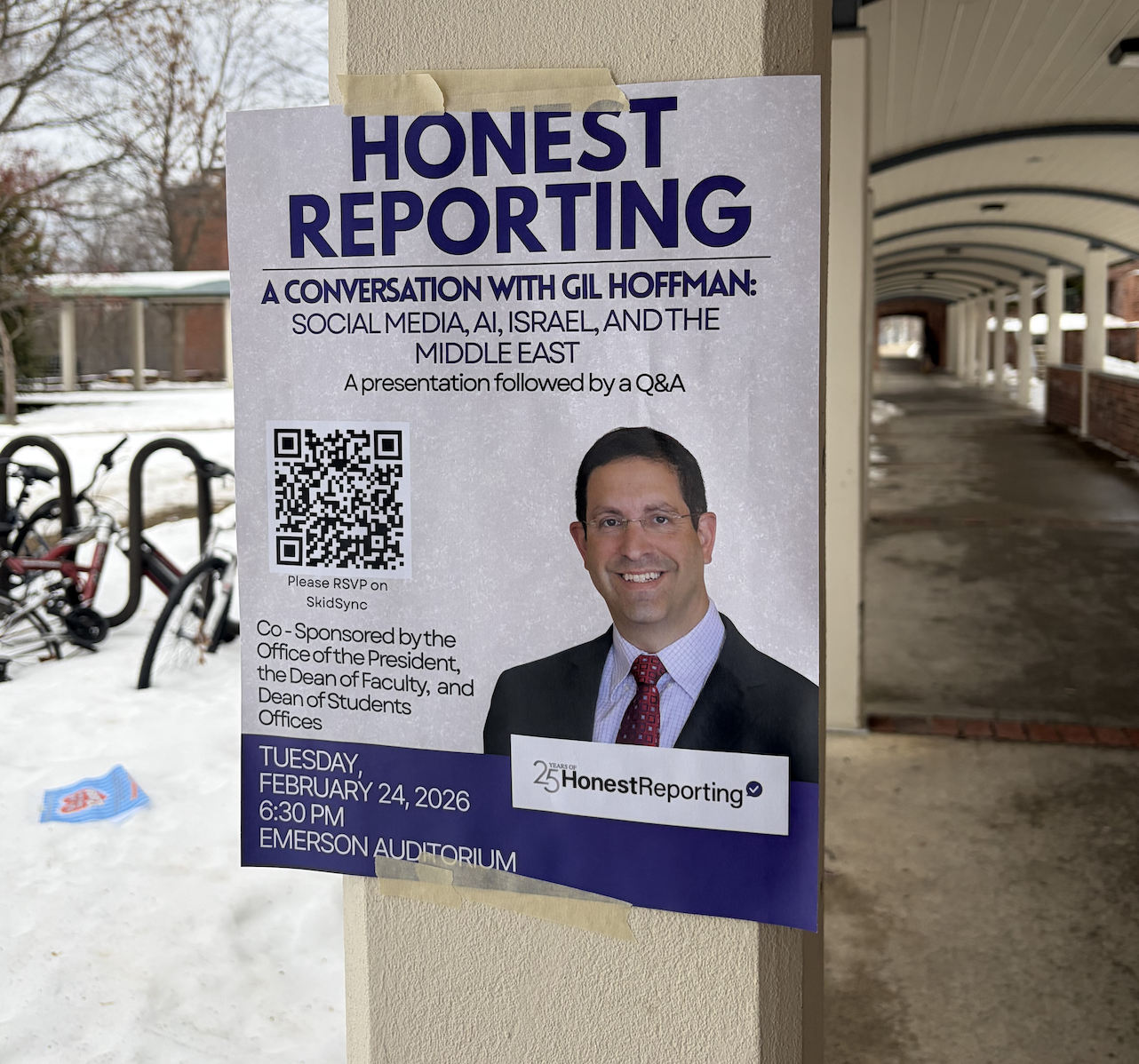
An intact poster on the Jonsson Tower walkway advertising the Gil Hoffman lecture.
Multiple parties were quick to condemn the vandalism. In a statement emailed to the community on February 23rd, Dean of Students Adrian Bautista cautioned that “acts like this send a harmful message to members of our community, and they are not welcome here. Our educational mission requires that we uphold the principles of free expression and encourage pluralism and dialogue across differences.” Skidmore4Palestine released a second statement on February 24th stating, “The Skidmore Coalition for Palestine condemns any form of violent or antisemitic protest of the Gil Hoffman event. That includes defacing posters with antisemitic imagery (horns, animal faces) that have historical connotations with antisemitic propaganda. The Coalition recognizes that Hoffman’s event is dangerous for Jews and Palestinians on campus, as he conflates critical coverage of Israeli military actions with anti-Israel bias.” Students interested in attending were required to RSVP via SkidSync as a preventative measure.
At 6:00 PM, thirty minutes prior to when Hoffman was slated to talk in Gannett Auditorium, the Skidmore Coalition for Palestine hosted a counter-response at the first-floor entrance of Palamountain Hall. At the entryway to the auditorium, event organizers and Skidmore leadership stood by to check people in, accompanied by campus safety. Directly across from them, coalition demonstrators played music—loud enough to be heard outside the hall but not inside it— carried signs of support for Palestinians, and handed out educational flyers. The group, however, was warned multiple times by campus officers that their demonstrations were too disruptive and audible.
We spoke with protestors who asked to remain anonymous, and they shared their initial reactions to the announcements that Hoffman would be invited to campus. “I was pretty outraged…that somebody with these views and this staunch position was being publicly invited by such major offices on campus,” one said. They continued, “We are a very nonviolent, peaceful group. We’re very focused on education… but we decided that this was not something we were going to accept.” They concluded that “...To know that tuition money that I paid and that my peers are paying is going towards this…I’m protesting that Skidmore is seemingly endorsing this by paying for this…especially when efforts put forth by students who support Palestine have been removed or censored.” Many students also expressed concerns about Skidmore College’s internal vetting process, questioning how a speaker whose views they regarded as misleading or inaccurate was approved to speak. Conversely, many students welcomed the College’s decision to host Hoffman, viewing the event as an opportunity to present a differing perspective and what they considered an important counterpoint in the broader conversation.
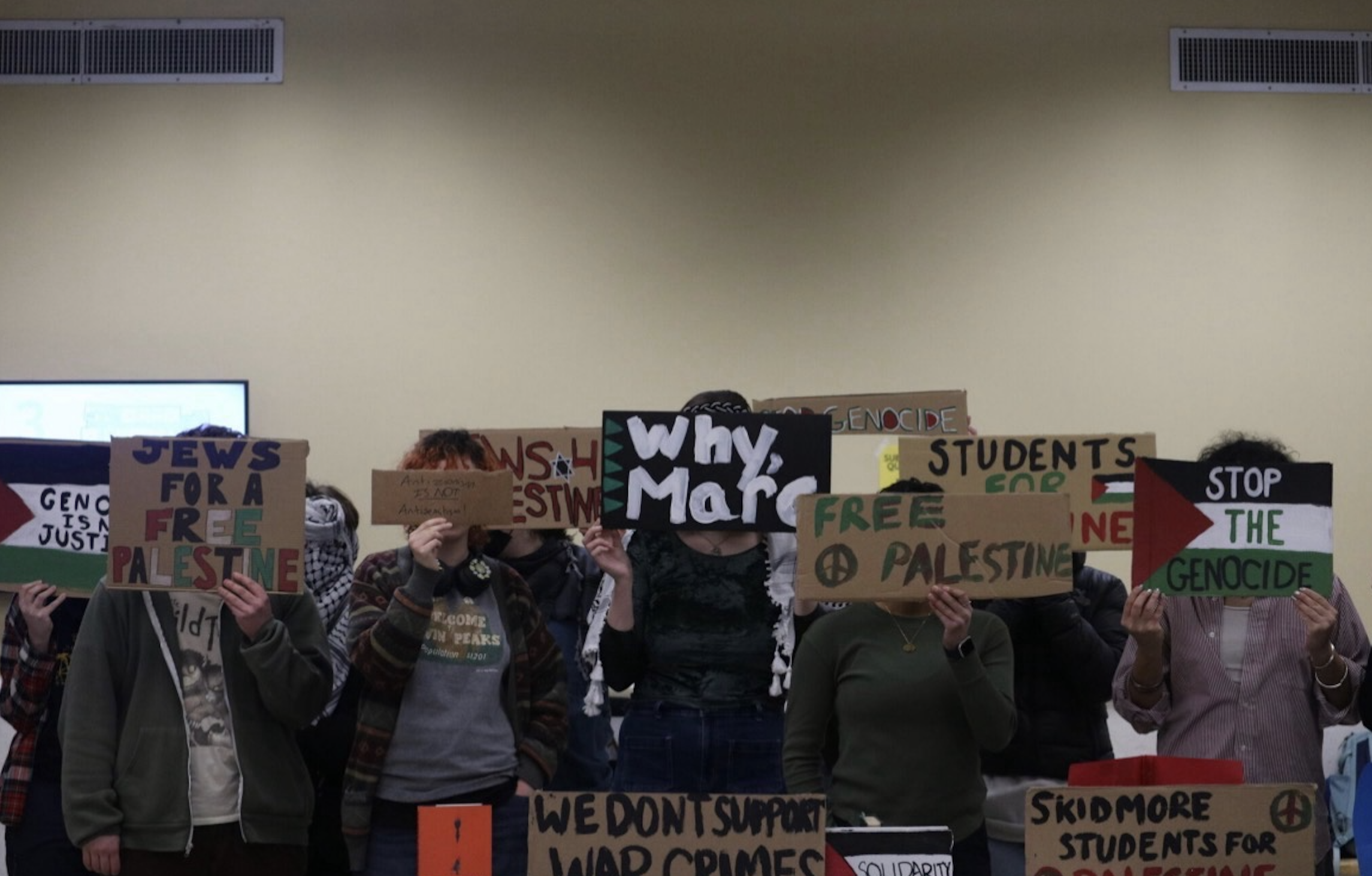
Student protesters and their signs outside Gannett Auditorium.
The event began with a brief preface from Dean Adrian Bautista and President Marc C. Conner, who reminded the audience of the necessity of free speech. Crucially, President Conner said that “pluralism looks like moments when people come to say things that we do not want to hear. But we know that others in our community very much want to hear those perspectives and those positions. And we're committed together to honoring them for all, because if that doesn't apply to all, then it applies to none.” He also thanked the students who organized the event.
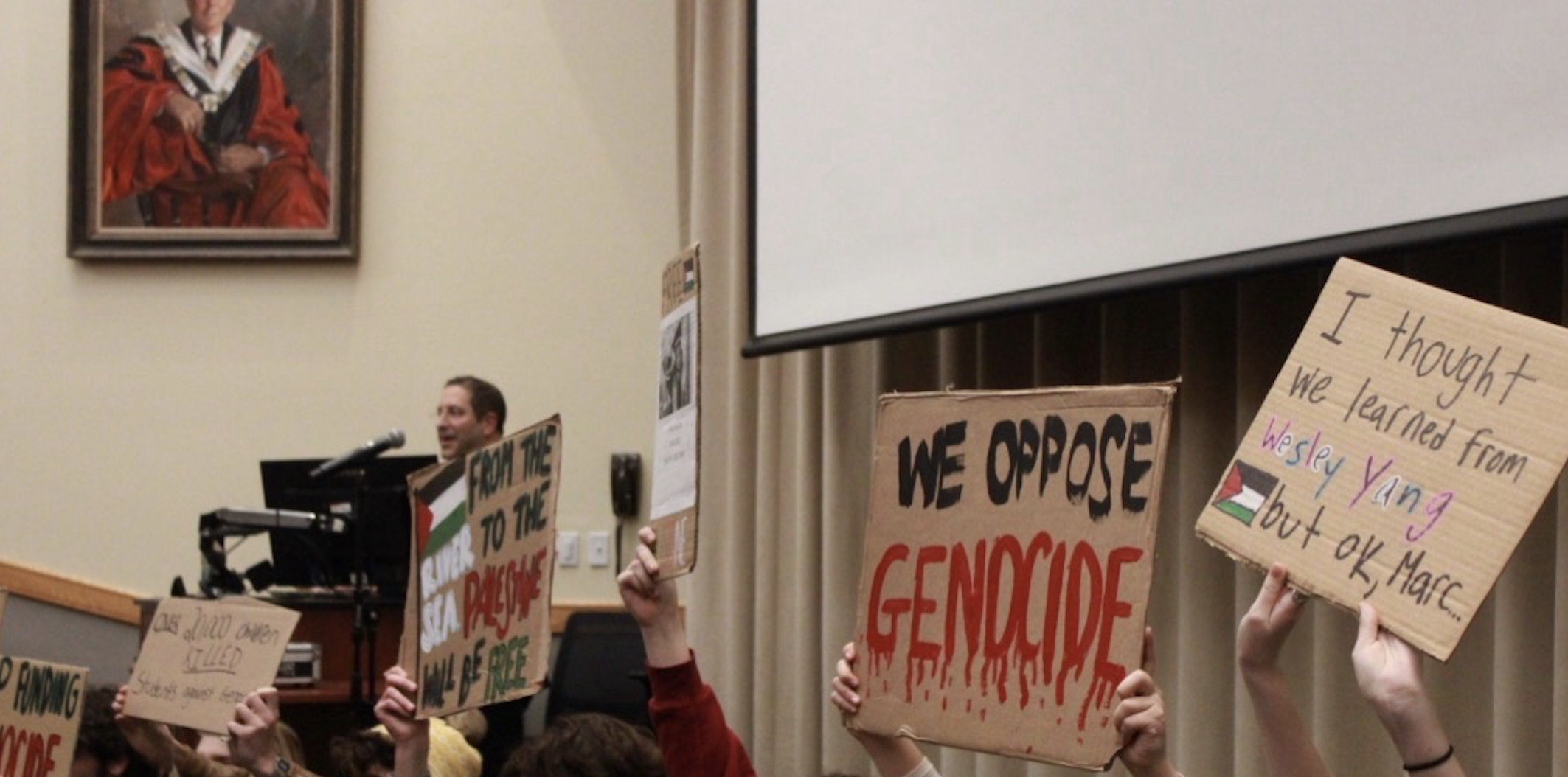
Student organizer Lila Glanville ’26 took the stage to introduce Hoffman and his credentials. Once Hoffman stood, demonstrators from the coalition both took their seats and formed a line at the front of the room and beside Hoffman, holding protest signs.
Hoffman began his lecture by wishing the audience a happy Ramadan. “As-salāmu ‘alaykum. And Ramadan Kareem.” His statements were met with giggles from the audience. Hoffman stated that he took two and a half years of Arabic at Northwestern and used it as a segway to urge the students in the audience to have an open mind. He stated, “You are at a university… I encourage you to leave your echo chamber tonight and learn about what's going on, where I come from.”
He transitioned into his main lecture by setting the scene. “I want to take you all back to Friday, October 6th, at 2:00 p.m. I had a speaking tour coming up that was to take me to Cornell and other universities around America, but you know, not too far away from here.” Hoffman shared that before his lectures, he tries to inform himself about the current security threats Israel is facing. He continued, “So, I met with Netanyahu’s National Security Advisor, and we went through the different security threats that Israel was facing. And he went through all the different fronts. After all, Israel is surrounded by countries that don't like us very much.”
Hoffman’s lecture was tense on all fronts. In the audience, students would laugh, cough, wave fact-checking signs, or—at various points—shout. Simultaneously, older attendees and students in support of Hoffman would loudly applaud. Rather than delivering an informational session about detecting false claims or biases in the media, for many, the lecture felt more like a disapproving finger-wag at the crowd. Once during the lecture, Dean Bautista had to remind the audience to observe respectful discourse.
Hoffman prompted students to imagine “what could’ve been” in the Middle East, as he has been to Gaza four times. “I don't know how many times any of you have been there. But my first time there, I was around your age… But I remember thinking how wonderful it would be if the Palestine leadership would make a sacrifice as necessary for peace with Israel.” Hoffman noted, “...it frightens me. How much support [Hamas], that Islamic fundamentalist terror organization has on campuses like these in America.”
Hoffman would also make several references to the atrocities of the Holocaust and even the recent killing of Hersh Goldberg-Polin, an American-Israeli who was abducted by Hamas, held hostage for nearly eleven months, and was found dead in a tunnel in Rafah. “I grew up with a great kid called Hersh Goldberg-Polin…He was held in a tunnel with 5 other beautiful people underneath a kindergarten, with Mickey Mouse on the walls. This is what Gaza had become. Hersh used to sit right back with me in the synagogue together with John. Unfortunately, just like with the Holocaust, no one could understand 6 million. There needed to be Anne Frank, because people can understand the young woman, a girl growing up. And Hersh became like Anne Frank of October 7th, you know, just a normal kid. Not the prettiest, not the oldest, and not the youngest, just kidnapped from a dance festival. And then just held underground and got murdered.” While most of those in attendance held very real concerns about the rise of anti-Semitism, there was not as much mention by Hoffman about the current lived experiences of Palestinians.
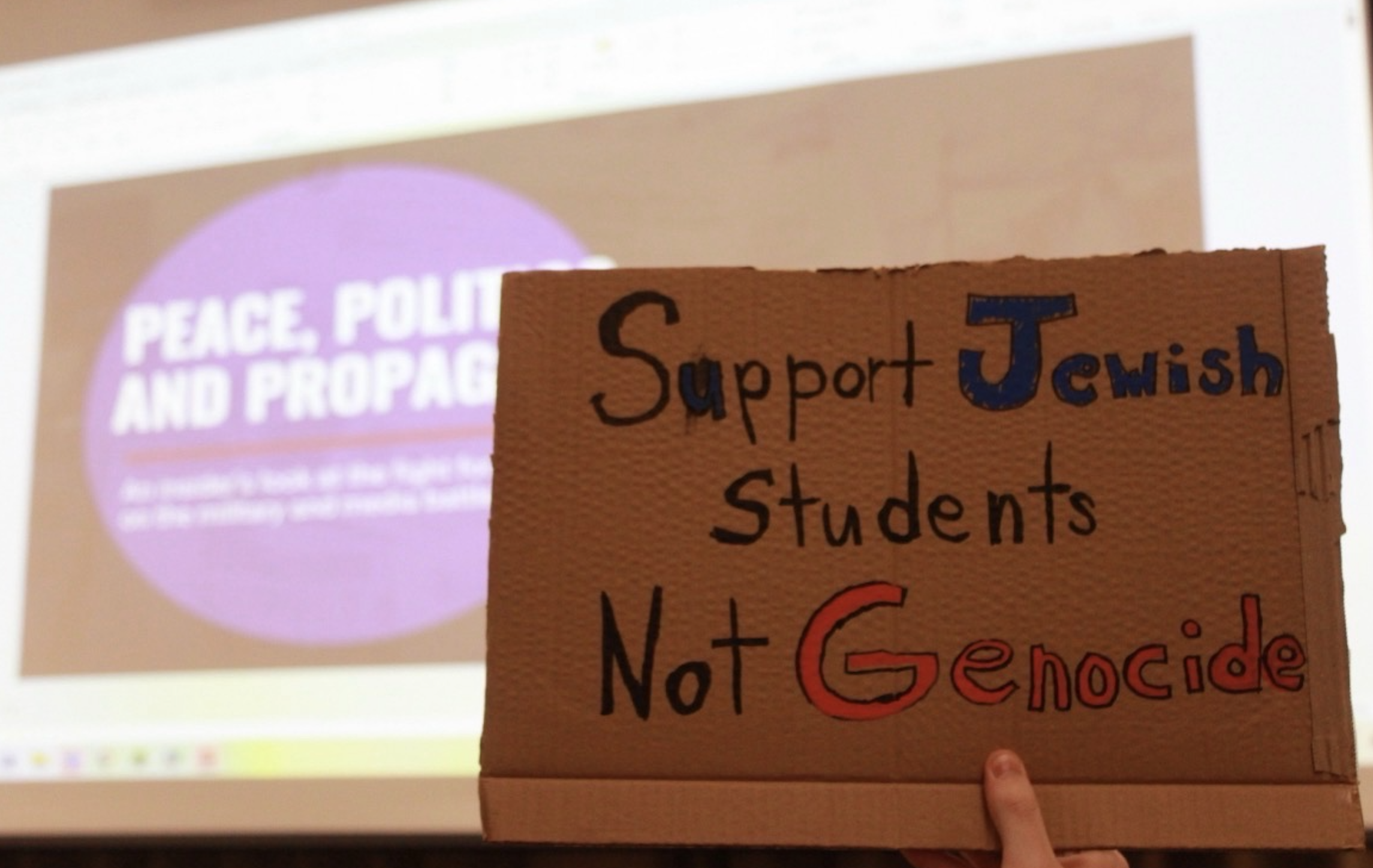
Hoffman repeatedly stated that the ongoing civilian casualties in Gaza were due to the missteps of the leadership in Palestine, drawing the focus away from the multiple international warnings of human rights violations that Netanyahu's administration has faced over its handling of Gaza. “And the people of Gaza deserve better.” Hoffman claimed, “They could have had better if they had leaders who cared about their people. And on behalf of the people in Gaza, I pray that you will protest against them against the people who hurt the people of Gaza so much.”
Further into the speech, Hoffman argued, “Israel did not target journalists for being journalists. Israel did not target the people of Gaza; it targeted Hamas, it targeted the terrorist organization that was harming the people of Gaza.” He conceded that, “Obviously, civilians get killed in warfare, and it's terrible, and the terrible organization that started everything on October 7th bears responsibility for that. Mistakes are made in war. But this was a war in which Israel did whatever it could to minimize civilian deaths on both sides of the border. Genocide is a word that has intent. The intent was to minimize harm to people on both sides of the party.”
Hoffman also presented a slideshow with various statistics about reporting and online impressionability. “If you see any report about what's going on right now in the Middle East, it does not mention October 7th. That is a lack of context. And it has to be corrected. Lack of transparency: every time a journalist goes into Gaza, embedded within the Israeli army, they say it in their reports.”
He then provided statistics. “Harvard-Harris has been taking polls throughout this war. Asking ordinary Americans, in the Israeli-Hamas context, who do you support more? Israel or Hamas? They don't make it wishy-washy – Israel-Palestine, Israel, Palestinians, I'm Pro-Palestine, I'm Pro-Palestinians. That wouldn't be a fair question. They made it more Israel or more Hamas. And right now, 72% of Americans say they support Israel more. 28% say they support Hamas more, which is terrifying.”
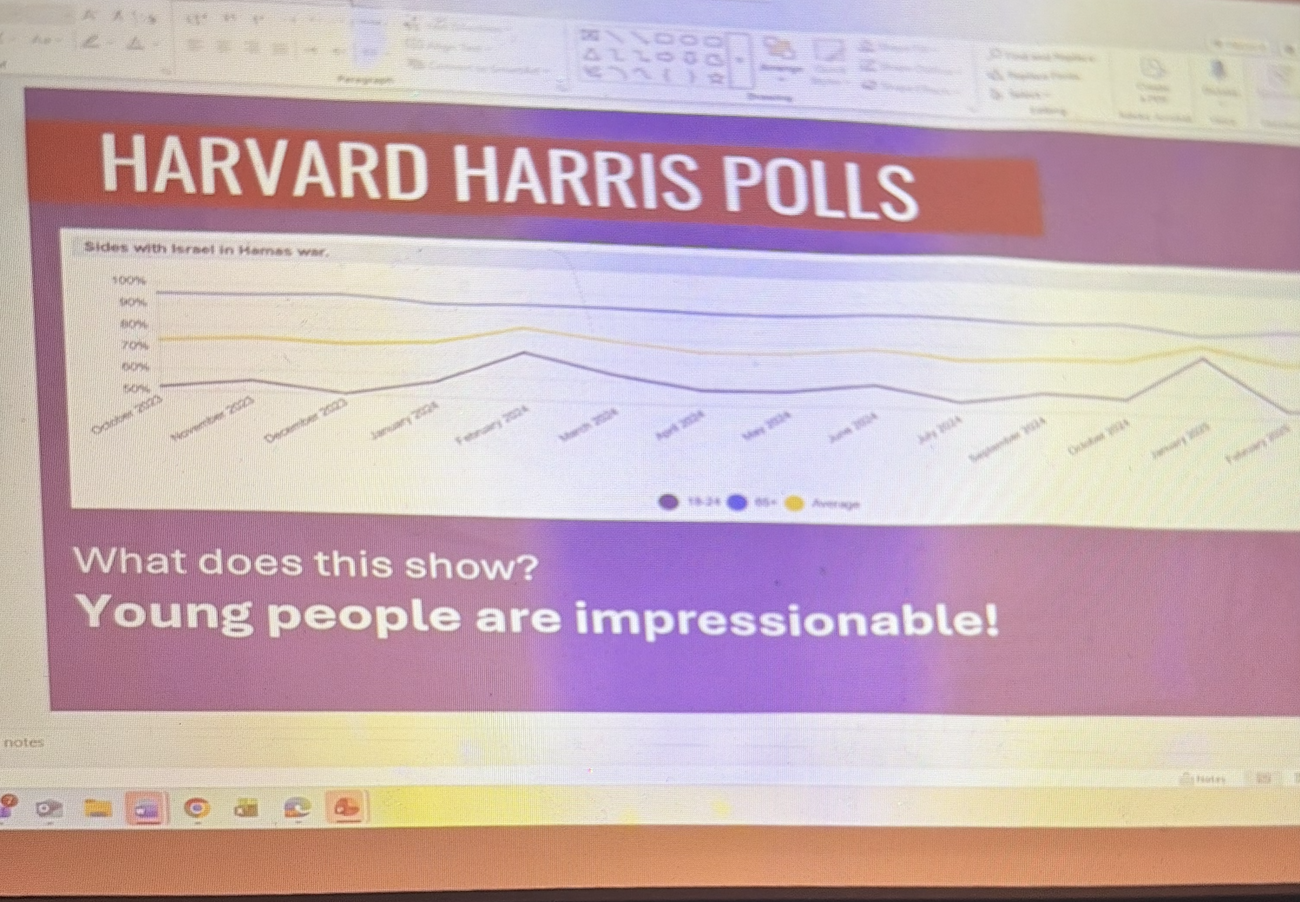
A Harvard-Harris poll that speaker Gil Hoffman featured during his talk.
In a more targeted moment, he referenced the generational divide in support for Israel. “You all change your minds all the time. It shows that you're impressionable or, I guess, whatever's more fashionable, whatever you saw last on TikTok.” He went on, “But the numbers are still very frightening for me, because... right now, it's 55% of people eighteen to twenty-four in America favoring Israel over Hamas. And just six months ago, it was 51-49 the other way. Meaning more than half the young people in America basically saying that they are in favor of going to dance festivals and murdering, raping, and kidnapping as many people as they can.”
He also made references to the reliability of AI. “On AI, when there are things that are wrong, argue with it. Make sure AI asks… did you ask your AI from multiple sources across the political spectrum? Don't be afraid to argue with your AI when it says things that are wrong.” This received more laughter and booing from the crowd.
Finally, the event ended with a transition to a Q&A, moderated by Besikof. One question a student posed asked, “What are your thoughts on the UN report of Israel using sexual and gender-based violence against Palestinian women and children?” To which Hoffman responded, “I'm not aware of a U.N. report accusing Israel of that. Israel is a society that protects women much more than every country in the Middle East by far, and we had a female head of state before any, before even America, and, you know, that is not what Israel is.” With little empathy or research to support the claim.
The final question of the evening was, “What are your thoughts on anti-Zionist Jews?” Hoffman concluded, “It’s sad for me because I'm very proud to live in a Jewish country, but descendants and the descendants of the anti-Zionist Jews prayed for 3000 years…And so I am willing to stay after with the anti-Zionist Jews, and talk to them more about my experiences living in Israel, and why we need to have Israel. Because anti-Semitism is spreading in the United States, and they might need there to be a Jewish haven someday.”
He concluded by stating, “And my last bit of advice is to be a mensch, to be a good person. Because if you are a good person, then people will trust you as a source of information.” Notably, mensch, a Yiddish term, means a person of strong moral integrity and honor.
In a joint statement, student organizers and event moderators Lila Glanville and Madelyn Besikof stated: “We are grateful that Skidmore supported this endeavor. We feel the event met many of its objectives. We are hopeful that this is the start of more open dialogue. We don’t have to agree with each other in order to learn from each other.”