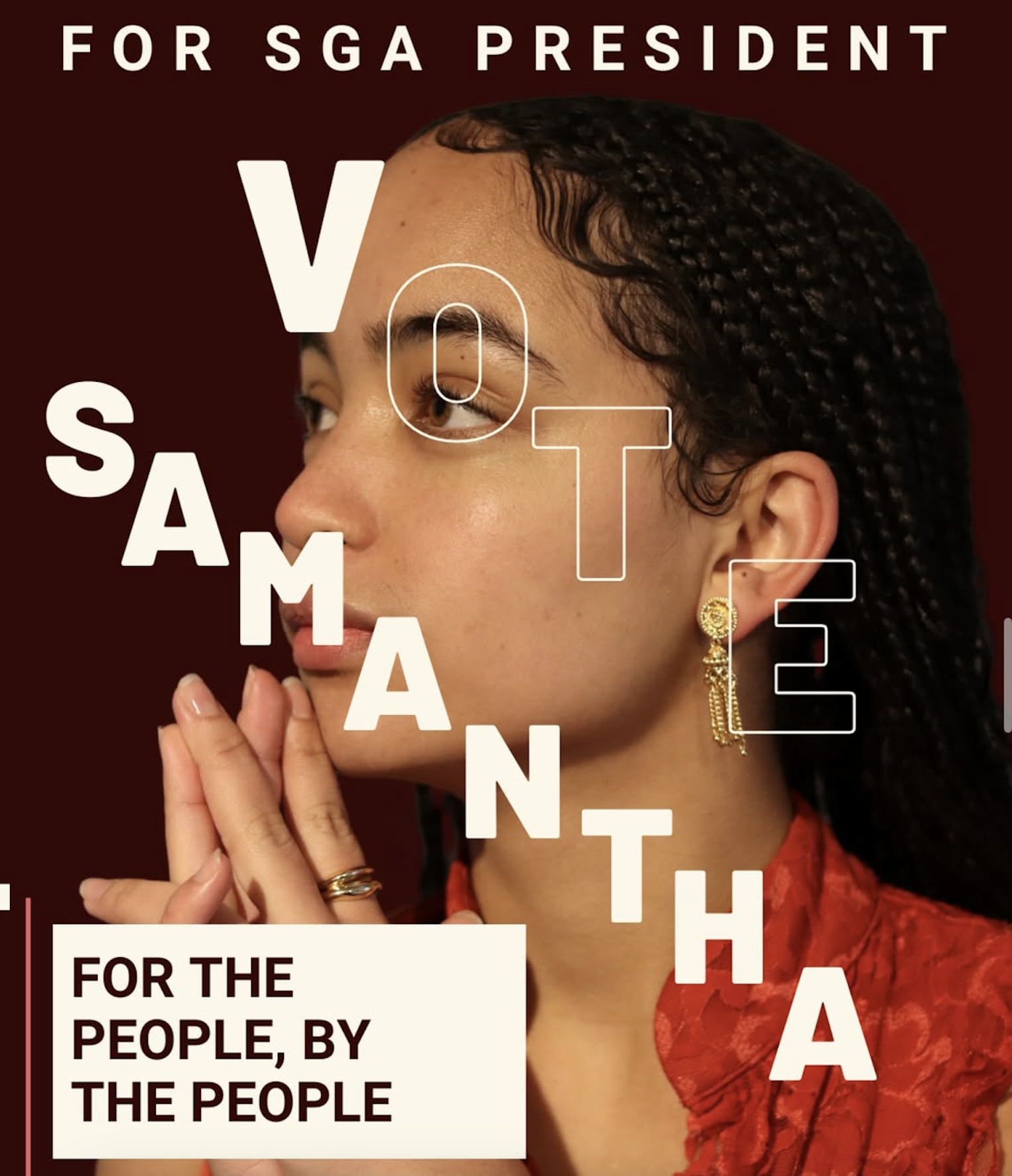
After an exciting election season, The Skidmore News was excited to sit down with the college’s next SGA President, Samantha Majiedt, to ask how she felt about her victory and her plans for the upcoming semester. As Samantha and I walked through the Case Center to the Wykoff Center, Samantha stopped to chat with students and faculty whom we passed by about upcoming student events. When we sat down to speak, we ended up covering a wide range of topics, including her campaign strategy, the student discourse surrounding the election both offline and online through YikYak, her priorities as SGA President, how to help students through the current fraught political climate, and the culture of SGA and how it can be seen as more approachable by students.
What was your mindset and strategy going into the election?
“I will say, just to be vulnerable, there were moments before the campaign when I felt: ‘Am I biting off too much to chew. Is this too much for me?’ Especially because Josh [Maxwell] is an amazing person and he does have the experience. So I felt a little worried about whether I was good enough.
But I had so much support from my friends, who gave me so many campaigning ideas. My main strategy, with the help of my friends, was to just go out and do lots of outreach. So if you looked at my Instagram, I went to the soccer team, I went to the PHE, and I went to as many people as possible, on-screen and off-screen. This was really helpful for the campaign and really helpful to garner support and actually learn what students wanted but also to share that on my Instagram for other students to learn.
From an SGA perspective, through outreach, we’ve made many connections. I know a lot of people who now know about SGA, who’ve taken part in the SGA elections, and who came to the debate when they had never interacted with SGA before. I will also mention that while we do have representatives from within SGA for athletics, for sustainability, I also think it's important to go to other students, other athletes, and other individuals on campus, not just the representatives.”
How did you feel about the discourse and wider student interest in the election, especially in the debate?
“First of all, I would just like to say thank you to the entire student body for engaging in this. It goes to show what we as students can do together! Imagine if we came together as we did on the debate night for protections for international students, like we show up to sports games, plays, or open mic nights? Gannett [during the debate night] was basically full. Debate night and the entire election go to show that we can come together as a community and what we do as a community can change lives.
I will also say, on a slightly different note, I think a lot of Skidmore students enjoy a bit of drama. Being at a small college, many people will grab onto many things for entertainment. I think this was also entertainment for many people, hence why they turned up. But they showed up, and at least they voted, and I think we could use a lot more of it in future events and future elections in a healthy way.
I will say that I am very disappointed in my fellow Skidmore students on YikYak. I am very anti-YikYak. I don’t like anonymous social media apps because it is so dangerous what people say when they are on those apps. We’ve seen hate, such as homophobia, queerphobia, racism, and xenophobia. It is so scary to think that so many of these people sit in my classes. I am not on it, but friends have sent me screenshots, and the amount of disrespect that has been spewed on YikYak towards both Josh and myself—I am highly, highly disappointed. Instead of going on YikYak and complaining, come and talk to us about it. Have office hours with us, send emails. If you genuinely have concerns, don’t go to an anonymous app; come and speak with us about it so we can fix it. While there were some critical things said, there were also many disrespectful things said. I hope that our fellow students hold themselves to a higher standard in the future because nobody should be brought down like that.”
How did you feel when you won the election? What did you think your campaign tapped into and brought such interest?
“I was just so happy. Other people were even happier than I was—my friends and the people I interviewed. And of course my mother; she was just so happy. There were people in D-Hall crying; it was beautiful. It wasn’t just a win for me—it was a win for us.
What I think I tapped into was making people feel heard. My friends helped me a lot with this, and one thing that I have heard on campus is that there’s not that direct communication from SGA to students, hence why some people may think it has been elitist. I wanted to make sure that students know that they can come and speak to me whenever they want. Like I said in my speech, I don’t just lead; I engage. I learned so many things that I didn’t know people have issues with. But if we don’t directly engage with those students, we’re never going to know these things.
While SGA has an Open Forum during Senate on Tuesday nights at 8 PM on the second floor of D-Hall, no one goes to that. A lot of people feel scared when they come to the Senate because they have to sit in front of a lot of senators who are staring at them. So, in my speech I said that if people aren’t going to come to us, then we have to go to the people in their space and engage with them directly.”
What is your first priority as SGA President? What’s most pressing for SGA to address right now?
“There are many, many things. I want to encourage more current SGA members to engage directly [with students], no matter your role. I think every SGA member should host an event in collaboration with a club, or host an open forum or a game night. I want people to see SGA members not as higher than students but as other students.
There’s also the Strategic Plan draft, which will be the final draft, so I want SGA to focus on that. I received student feedback on the strategic plan and relayed that information to the cabinet and to Joshua Woodfork, who is the Vice President for Strategic Planning and Institutional Diversity, because this is the next five years of the college’s future and students can have such a huge voice in this. This is housing, this is the curriculum, this is finances, and this is how the college views its students. This strategic plan is so important for students to engage with.
The third important thing is to try to assist students under the current Trump administration. I think everyone in SGA has a role to play when it comes to protecting and servicing our students. There is a lot of fear right now. Our fellow clubs, like AHA (African Heritage Awareness), Ujima, and Hillel, could all be impacted. How SGA works could be impacted; my current position as VP of Institutional Diversity might not even be here.”
As you said, we live in a very fearful time, especially for international students and students of color. As SGA President, how do you plan to reassure students who are fearful and bring them together?
“I am so glad you asked this question! On Monday (April 13th), at 5:30 here at the Wyckoff Center, the committee on institutional diversity hosted a “Where are we now under the Trump Administration” forum with a bunch of faculty, administrators, staff, and students. We spoke about what happened in the past few months and weeks, and we’re looking forward to seeing how we as a college can help our fellow peers.
I will also have office hours, and the Committee of Institutional Diversity is always open to people. I am also in conversation with CIGU (Committee on Intercultural and Global Understanding) with Joshua Woodfork, Sara Vero, Dr. Brooke Paradise, and a bunch of administrators, and one of our pressing and constant conversations is: how are we trying to protect our students?
Sarah Vero, head of Human Resources, is an amazing resource. She and campus safety have been working on a website that explains the regulations and protocols around federal policing on campus. I have also been provided with resources for students to understand their rights, contact procedures, and due processes, so if people would like those resources, they can contact me, and I will happily provide them.”
What are more long-term goals and resolutions that you would like to accomplish during your time as SGA President?
“First of all, I would like to repair the relationship between Accessmore (Students with Disabilities Advocacy group). Over the past few years, there’s been some tension around that relationship. There’s also the question about how much of this is SGA and how much of this is an institutional concern, and I say it’s both. I’ll also continue to work on our initiatives, like the transit initiative—which will transport students with injuries or disabilities from point to point on campus—accessible seating in D-Hall, and signage.
There are a lot of disconnects between some clubs and finances, and I would love to collaborate with the VP of Financial Affairs in the future to make the funding process within SGA clearer to clubs so that they can understand why some funding is being cut and why this process can be so difficult.
I also want to try and help our athletes as much as possible. I think that while there is that divide between student-athletes and students, people also forget that these aren’t just athletes; these are our fellow students and fellow friends. I've spoken to a lot of athletes about a hierarchy of sports and their popularity. For example, most people might attend the basketball games, the lacrosse, or the football games, and that kind of decreases for other sports that are lower in the ‘hierarchy.’ This applies to non-sports students too. I have spoken to different groups on campus who said that while there needs to be more support for games and events, there also needs to be an effort to go to the theater department events or an event in the STEM department, for example.
So how can we bring different groups together? Well, during debate night, people from all walks of life were in Gannett! So using the elections as a template for bringing people together is important.
One smaller thing: I think it is unfair that only SGA members have such direct access to cabinet members and administrators. How can we bridge the gap between administrators and students? Because we can’t speak for everybody.
I have heard from some seniors that they don’t feel the senior gift is fair. They have to contribute these funds when they need to be saving up their money for life after college. Seniors who have spoken to me have asked if there is a way that we can improve senior-alumni relations.
I also want to focus on funding for different departments. If you go to my Instagram, I spoke to an art student about funding for materials in the art department because students have to pay for materials themselves, and they get really expensive. How can we allocate the resources in advance to fund projects for things on campus? How can we utilize our institutional resources to help students financially, especially at this time?”
You campaigned as an outsider, someone who can bring change and new ideas to SGA. How do you plan to work with established SGA members and build a rapport with the SGA and the administration?
“I believe I have a good relationship with administrators already. I meet with some of them on a weekly basis, and I have established a good relationship so they know me as engaged, active, and ready to go out and do anything. Like I always say, engagement is the first step, so I am engaging with cabinet members, with administrators, and with faculty and staff.
But we are all stepping into the next semester with different dynamics or different positions, so one thing I am doing is having meetings with SGA members, both on a formal and informal basis, to build trust and look at our goals as fellow colleagues.
When I say “outsider,” I mean as an international student. I know what it feels like to be worried about deportation or my visa. I am also a student of color. Speaking for myself and other friends, I know what it feels like to have no support because my family is not here. I try to remind SGA members that there are students on campus who are literally scared for their lives and don’t have access to the administration as easily as them. I know what it's like to be an outsider, and because of that, I know how we can better engage with students.”
How do you feel about the internal culture of the SGA, and how do you think that culture is reflected in how the student body sees the SGA?
“In this academic year, this is the most engaged I’ve seen SGA members. I was worried in my freshman year that students wouldn’t be engaged in SGA and that they were just there for the resume. But what I love about our current group is that people are in student government because they genuinely care.
One thing I would like to work on is our communication and our honesty with each other. I feel like at Skidmore, people prioritize social harmony over honesty, and I think it’s reflected in the whole community. I think it’s a Skidmore culture thing, where instead of being honest and having those challenging or necessary conversations, people want to gloss over it. I would like to prioritize honesty and transparency in everything SGA does. I’ve noticed that people appreciate that, and it helps to build trust in and improve relationships within SGA.
I’ve also noticed that in the previous days of SGA, it can sometimes be an echo chamber. I want to emphasize to SGA members that we need to disagree, not that it’s simply alright to disagree. We need to disagree. A healthy organization challenges its members and pushes them to be inventive. So for us to have conversations, we need to prioritize honesty in our criticisms. I want to highlight that we can disagree, but it needs to be done in such a way that is completely respectful, and we can do that through trust and communication.”