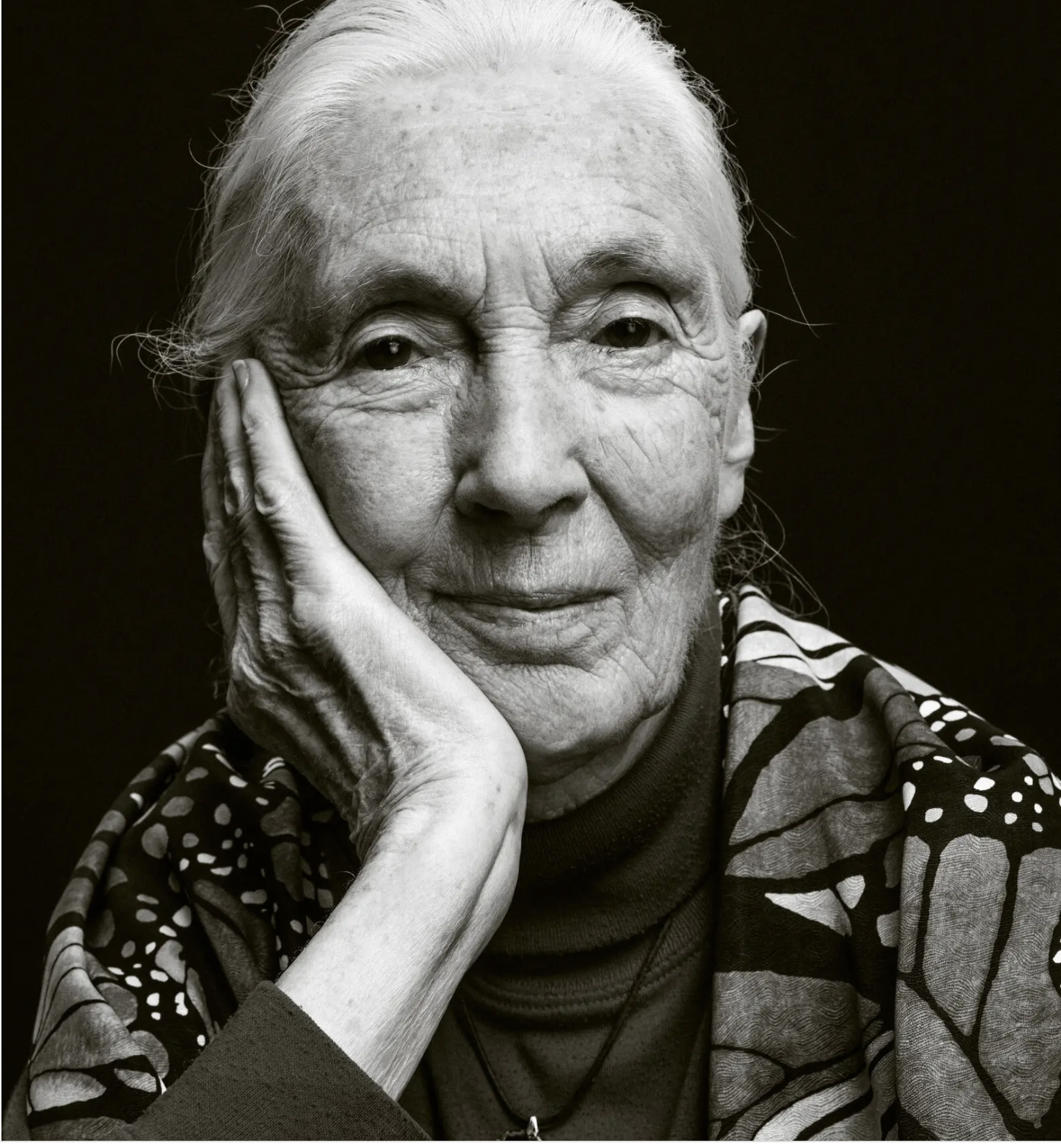
Who is Jane Goodall? asks author Roberta Edwards and Who HQ on the cover of Jane Goodall’s illustrated children’s biography. As a fifth grader who had mostly checked out books about various dog breeds—because I was determined to convince my parents to adopt a dog—I had no idea who this woman was.
However, being an animal lover, I chose this book from the shelf in my classroom’s library. The cover features a blonde-haired, blue-eyed woman crouching on a forest floor. She wears practical clothing—a gray button-up and gray cargo shorts. And, of course, her head is gigantic and disproportionate to the rest of her body, which is a trademark of the “Who Is?” and “Who Was?” books. The cover caught my eye, and all I could think was I love animals, and she loved them, too.
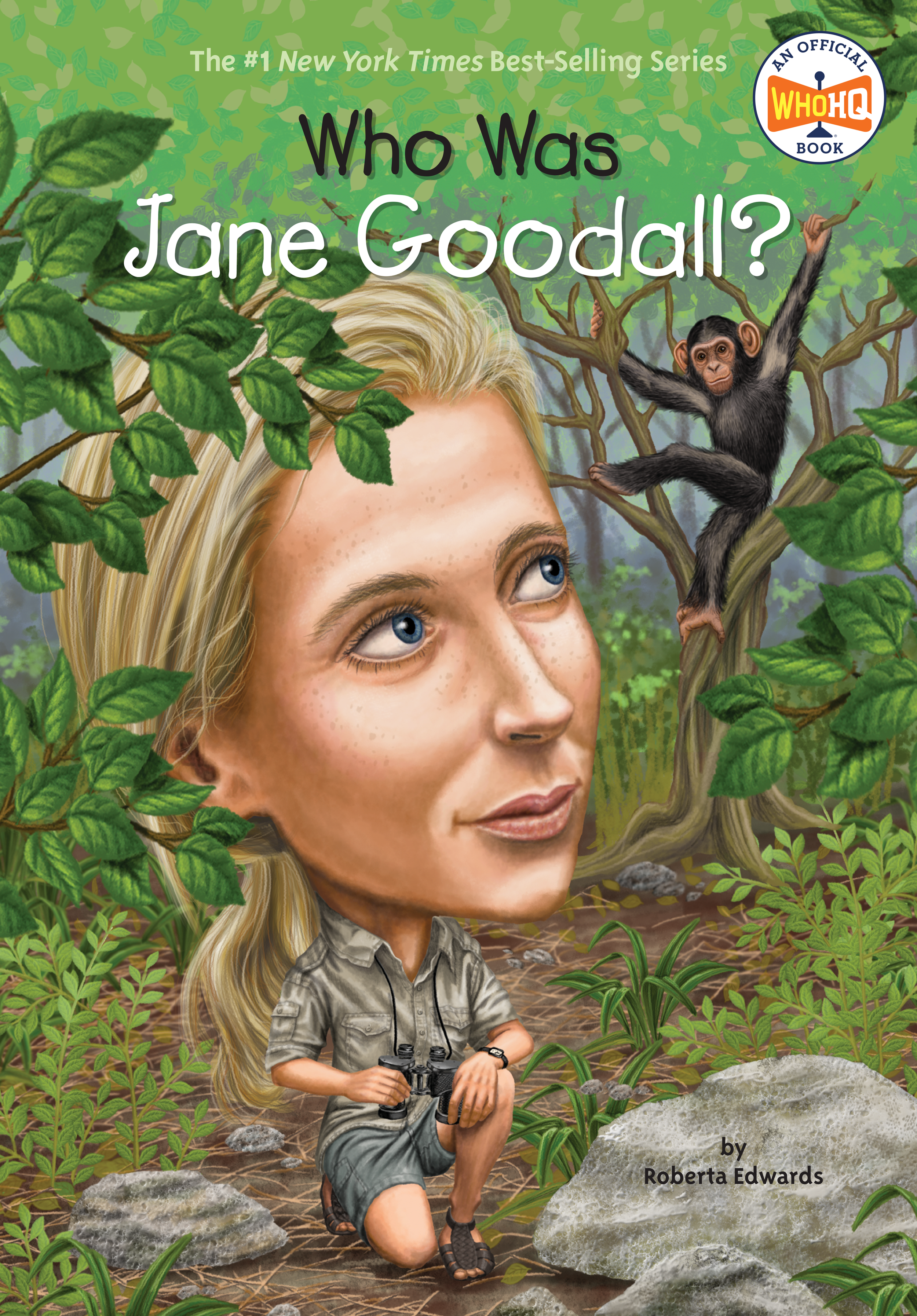
The updated title, Who Was Jane Goodall? by Roberta Edwards and Who HQ.
Jane Goodall was fascinated by chimpanzees from a young age. She often carried around a stuffed chimpanzee named Jubilee, which was, comically, almost half her size. Her parents encouraged her love of wildlife, and she often spent time with her family pets—her dog, Rusty, a tortoise, and a pony. When she learned how to read, she enjoyed books such as Tarzan and Doctor Doolittle.
While dreaming of fieldwork, Goodall attended secretarial school, where she learned typing, bookkeeping, and other skills. Her career truly began, however, when she visited a friend in Kenya at her family’s farm. There, she met the man who would help her get her foot in the door — Dr. Louis Leakley. During a phone call, Leakley was so impressed with Goodall that he offered to help fund an expedition to Tanzania, where Goodall would begin her research.
After arriving at the Gombe Stream Research Center in 1960, Goodall began to closely observe and create intimate connections with 30-40 chimpanzees, even naming some of them. She discovered that chimpanzees were more resourceful than researchers believed—they are capable of making and using tools to make tasks easier, such as searching for food. They use distinct calls to communicate, and, above all, they show deep compassion and cruelty toward each other, much like humans.
Beyond her fieldwork, Goodall was also deeply invested in conserving the habitats of and protecting these magnificent animals. In 1977, she founded the Jane Goodall Institute, which has become one of the largest nonprofit global research and conservation organizations.
Jane Goodall passed away at the age of 91 on October 1st, 2025, while on a speaking tour in Los Angeles. To those who had the privilege of knowing her, Goodall was knowledgeable, hopeful, and gentle. She believed in not what the world was, but what it could be. Her legacy lives on through her incredible research, and she continues to be a role model to young women everywhere.
I remember Jane as an inspiration. She is a woman who tirelessly worked to understand and advocate for wildlife, despite growing up during a time when women were not always taken seriously in scientific fields. Her first loves were the chimpanzees, who cemented her legacy. We can all learn from Jane to treat all creatures with empathy and work to understand them. We have voices and resources to advocate for ourselves—chimpanzees do not. They are our closest living relatives. By learning about them, we learn more about ourselves.