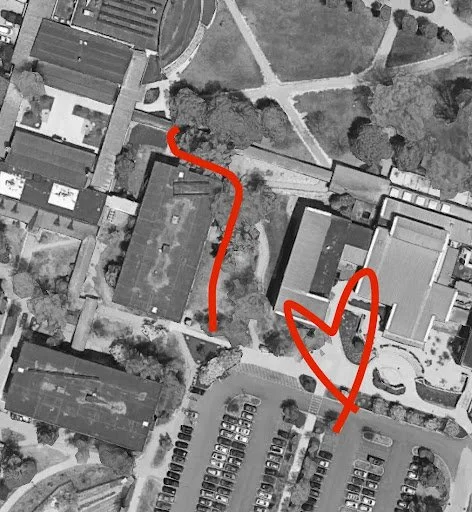
I’m sure you’re familiar with this path. It begins roughly at the edge of the parking lot, behind Case, and traces the outline of Wilmarth through a stretch of grass or snow until the stairs that descend from the Case–D-Hall causeway. The path exists because it is a much quicker alternative to the winding ramp.
Much like other paths at Skidmore, it gets frequent daily use. Students venturing to South Quad, the gym, the Tang, or beyond, correctly identify it as the fastest route from hubs like D-Hall or North Quad.
Crucially, however, this path differs; it is unpaved. Though its definition varies along its length, it remains visible, a strip of bare earth trodden by countless Adidas and Doc Martens. In winter, it forms a channel through snow drifts, while in fall it is remarkably clear of leaves.
Detractors of this path might claim that one could take the stairs through Starbuck Center for a similarly direct route. However, this requires a certain amount of foresight that seems to evade me when choosing my path. Besides, it means traversing an extra two sets of double doors and an awkward staircase.
I imagine that this path is a liability. It is true that unpaved ground presents a tripping hazard, and the path remains steadfastly unprotected in icy winters. However, I would posit that any amount of walking anywhere involves some risk, and that the added danger is not unreasonable. Besides, we must duly compare it to the added dangers of the slimy, odorous, and unpleasant hike up the Starbuck Center stairs!
To its credit, this path provides contact with a non-humanmade surface. Skidmore College is a college in a forest, and it prides itself on a certain ruggedness, being at the edge of the Adirondack Park and home to the celebrated North Woods. Walking this unpaved path in any season, with the soil packed beneath my feet and a fine dusting of pine needles sprinkled about for good measure, feels restorative. It invokes, perhaps, camping–or at least a small diversion into a more natural state of mind. The path serves as an outlet, representing just the right amount of civil disobedience against the sidewalks of the powers that be.
It is a textbook “desire path:” a path created purely by foot traffic which compensates for a flaw in an existing planned path. Thus, it is a cultural artifact of Skidmore. Anthropologically, the path is of the utmost importance.
Yes, the path is flawed. It packs down soil, making it unable to sustain life. It contributes to erosion. The path is not welcoming to those who cannot take stairs, such as wheelchair users. It is, by nature, rebellious; the path is symbolic of an inefficiency in the official path network, which is ideologically inconvenient, I’m sure.
However, the path is one of the rare marks on the Skidmore landscape made directly and entirely by humans. It provides a brief respite from artificial surfaces as it winds amongst pines. The path is a small act of self-determination by the walker, making their day more interesting and vindicating their choice (it is quicker, after all).
In short: I hope the path is never paved!