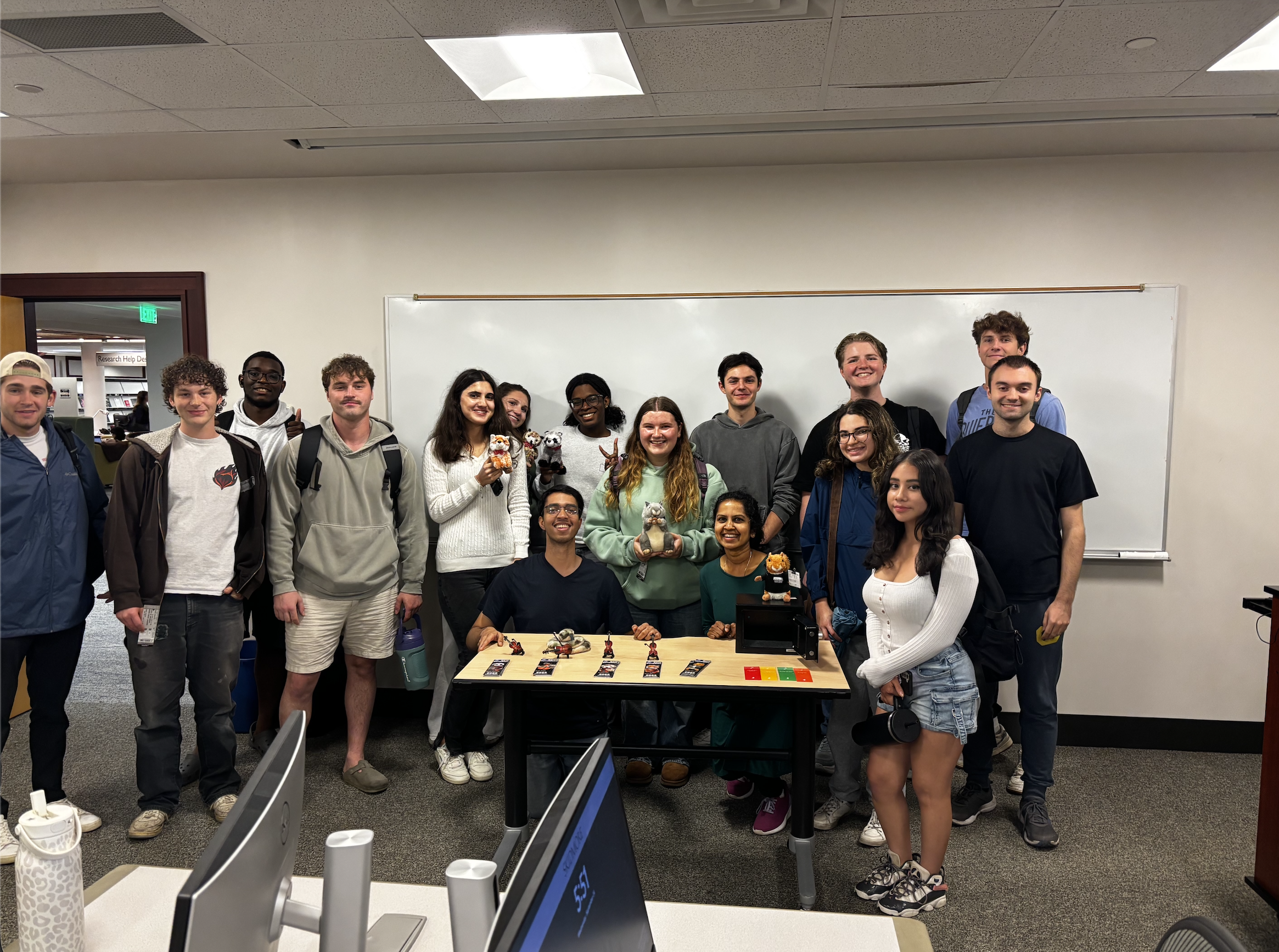
Every fall semester, Skidmore hosts “Scribner Seminars” for its incoming first-year students. These seminars explore, through meaningful discussions and written analysis, topics ranging from “Womanhood in Russia” to “Codes and Cyphers” to Buddhist tradition. Through the classes, first-year students adapt to college-level writing, reading, and learning with the help of their professors and Peer Mentors.
This fall, a unique and eye-opening seminar deserves to be highlighted. “Defense Against the Dark Arts: Technology Edition” is currently being taught by Professor Aarathi Prasad, along with Peer Mentor Azizul Hakim ‘26. Professor Prasad has been teaching in the Computer Science Department since 2017, specializing in systems and security. Azizul Hakim, who will graduate in the coming spring, is a computer science and sociology major.
The eye-catching title of this seminar uses the idea of wizards and witches—taken from the popular franchise Harry Potter—learning “Defense Against the Dark Arts” in a productive manner, the same way college students should view our technological progress and combat the challenges and advances that arise. According to Professor Prasad, the class includes research on “why people use technology” as well as “how people don’t use technology.” She asks the students in her class to reflect on the question, “When you're using your tech, are you using it in a way that is helping you?”
When designing the class, Professor Prasad ensured its content would be “accessible to any student,” regardless of their level of familiarity with computer science. She selected readings that reflect on technology and its impacts on different fields, such as history, gender studies, and psychology. Professor Prasad “tried to come up with topics that students could relate to,” choosing the readings based on feedback and the interests of students in her class. When she found there were many history majors in her class, she went out of her way to find a reading centered around the Luddites and their groundbreaking revolt against the Industrial Revolution, an excerpt from Blood in the Machine: The Origins of Rebellion Against Big Tech by Brian Merchant.
The bulk of the reading for the class is taken from the book Technically Wrong: Sexist Apps, Biased Algorithms, and Other Threats of Toxic Tech by Sarah Wachter-Boettcher. The book reflects on how “apps don't address the needs of the individual users... software is usually built to target one certain kind of people; it doesn't incorporate or include everyone.” In addition to the readings, Professor Prasad plans to assign various films and TV episodes to her class, such as a “Black Mirror” episode. Furthering her efforts to create an accessible and relatable classroom environment, she plans to engage the students through methods beyond class discussions. Her seminar will visit the IdeaLab this week to work on a project that will increase their understanding of positive ways in which tech can be used.
The buildup of all this research leads to the hands-on final project, where the students will choose a smartphone app and test a hypothesis on five participants based on a specific feature. For example, if participants’ friends do not comment on their post, the participants may feel negative emotions. Professor Prasad notices that the positive aspects of these apps are always highlighted but wants to see the students’ perspectives on how tech impacts us to examine the negative space as well.
The topics to be discussed in “Defense Against the Dark Arts” may be more important now than ever before. Prasad mentioned that “especially as incoming college students, technology is going to play a large role in your academic lives as well as your personal lives” and hopes that the class will properly guide her students towards the use of tech that has a positive impact. She reflected upon the increasingly pervasive use of artificial intelligence in the classroom and beyond: “I do not want to have A.I. write something because that is not how I would write it... It kills creativity in some ways.” Nevertheless, she understands that “we are not going to get rid of it” and has had ongoing conversations about its proper use and ethics with her upper-level computer science students.
From a student's perspective, the class has been spectacular. Although the semester has just started, we have already discussed a multitude of topics. The class is a mixing pot of different opinions and experiences, allowing for the discussions to be animated and illuminating. I went into the class strongly opposing artificial intelligence but not having clear words for why. Already, I can better articulate the negatives of A.I. while also learning how to look at the positives with an open mind. Considering the pervasive nature of all realms of technology, each student in the class has a different, equally valuable perspective that allows for accessible and vivid discussions. Every voice is heard equally. I have never had the chance to learn to code or understand the inner workings of media algorithms, yet I am still able to fully participate in the class; the seminar has provided a path towards connecting with technology regardless of educational status. I think this is important in and outside of college classrooms. So many feel powerless against tech because they are not able to understand it. Professor Prasad has flipped the narrative: the user ––rather than the developers––of prominent technological applications can, and should, control the narrative of their relationship with it.
Professor Prasad, though exploring ways in which the software may positively impact her students, stated that she “would encourage students not to rely on it because we still don't know how it’s going to affect us––it's still so new” and recommended that “students should have a conversation with their professor about how to use (or not use) A.I. in the classroom... what works for one class may not work for another.” In this way, her class and personal research hold space for all the facets, both positive and negative, of technology. Professor Prasad mentioned that, in addition to various research-based journals, she “learns from the students” about emerging technology in the social world, especially as “it changes every day.” She hopes for the seminar to expand not only the students’ perspectives but also her own. When asked what knowledge she hopes for students to walk away from the seminar with, she replied, “I hope students will look inwards and realize how technology is impacting them, and they will walk away feeling more confident about their relationship with technology. That's what I am hoping to get out of it too”.