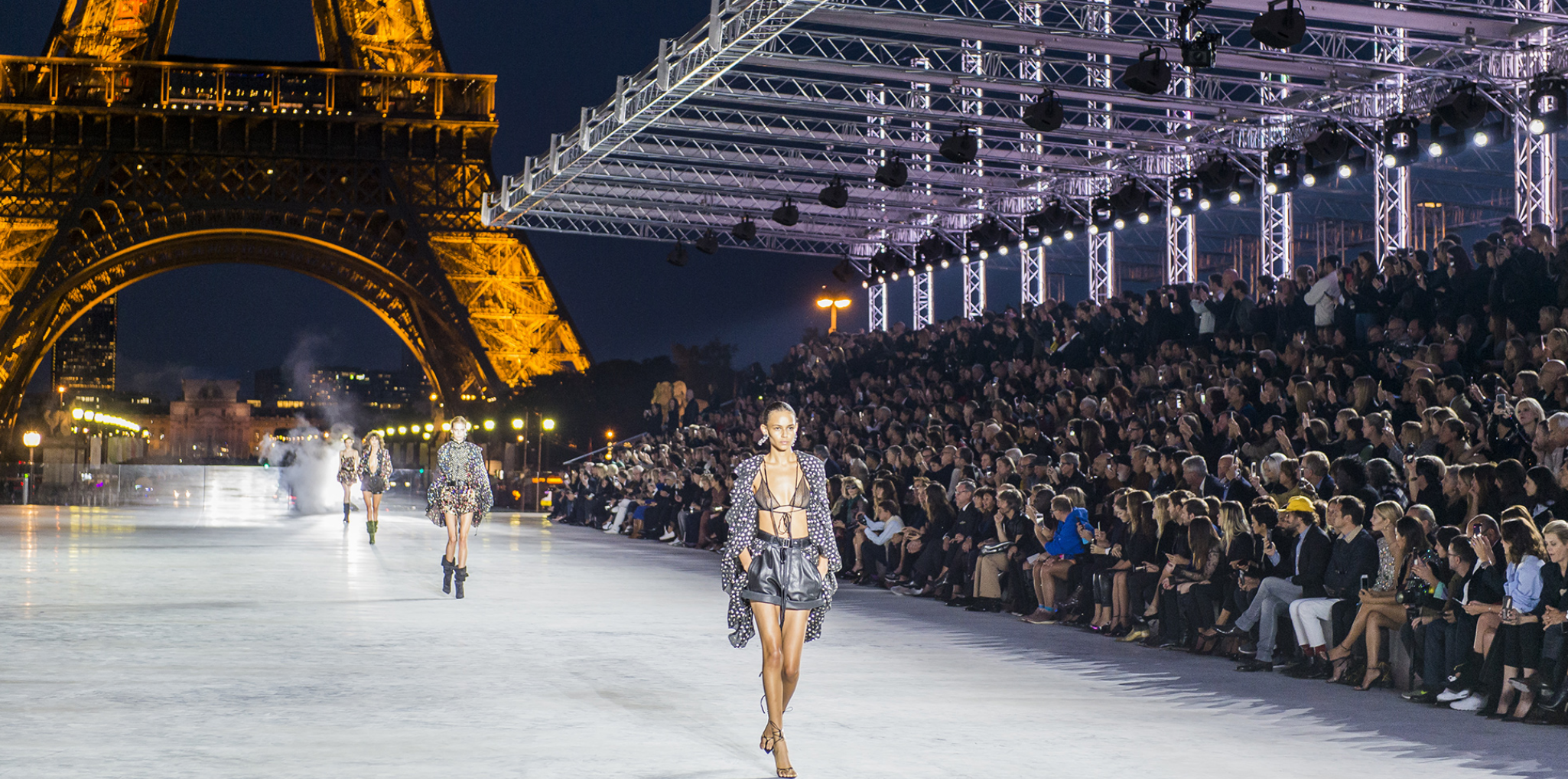
This season has come with significant changes to the world of designer fashion, with several notable fashion houses taking on new creative directors. The infamous Demna Gvasalia, known for his work at Balenciaga, is one such notable example. Gvasalia recently debuted as creative director of Gucci in Milan to much excitement and divided opinions, while his old role at Balenciaga went to designer Pierpaolo Piccioli, who previously worked for Valentino. The collections that have come out as these fashion houses attempt to reinvent themselves have inspired both excitement and trepidation for fashionistas, especially amid turbulent earnings in the luxury sector. However, arguably no shows were more highly anticipated than Chanel and Dior’s newest Spring/Summer collections in Paris: the first womenswear shows to come from the brands’ new creative directors.
Matthew Blazy’s debut collection for Chanel is both an elevation of Chanel’s house codes and a sneak peek at what the house could look like through his creative vision. The show featured blazers and coats with bold colored outlines typical of Chanel, as well as the brand’s signature tweed suits with clever tweaks: the suits were looser, more youthfully constructed, and had the notable addition of fringe—a touch Blazy added to the house’s uniform. Blazy’s personal sensibilities could be seen in the inclusion of sumptuous silk shirts and gowns, fabulous, strongly cut coats, and feather motifs.
Though Jonathan Anderson made his first jump as Dior’s Creative Director earlier in June with his Dior Men’s Show, it is his debut women’s wear collection that many have been anticipating as the true first glimpse of what an Andersonian Dior could look like. This most recent show is a beautiful synthesis of Anderson’s unique fashion instincts and the house’s history. The collection featured sculptural, almost statuesque dresses with draping fabric. The historical elements could be a visual reference to Christian Dior’s legacy as a historic house, as he was one of the world’s first major couturiers. Indeed, history seems to be a fixation of Anderson’s, as he has forgone the more modern font logo in favor of the brand’s original lettering. More of Dior’s legacy could be seen in cinched bar coats—allusions to the house’s New Look of the twentieth century—and the use of floral patterns and bow motifs. While much of the collection paid its respects to the past, other designs were whimsically and originally Anderson: many garments were strangely angular; skirts protruded off of models’ bodies in bell shapes, and blazers poked out sharply at the sides. The tips of shoes ended not in straight points but irregular arches or transformed into blooming flowers, and models wore hats similar to those worn by 18th-century French soldiers.
Blazy and Anderson’s appointments to their new positions are undoubtedly due, at least in part, to their recent work in revitalizing declining brands. Under Blazy’s stewardship, the once stagnant Italian fashion house Bottega Veneta has become one of the hottest brands on the market. Blazy’s command of Bottega’s legacy in leather work—particularly, his ability to transform leather into unexpected garments and his sharp instinct for tailoring—have made the brand popular with consumers and celebrities alike: the brand’s signature braided leather handbags have become frequent sights on the arms of celebrities such as Jacob Elordi, who has a particular penchant for the ‘Andiamo’ bag. Jonathan Anderson achieved comparable growth for the Spanish brand Loewe with his creation of the brand’s now emblematic ‘Puzzle’ bag, his infusion of pop culture into Loewe’s brand identity, and his playful use of silhouettes and texture, all of which has made him one of the most highly regarded avant-garde designers working today. But the parallels in this story do not end here.
Chanel and Dior share, in many ways, similar histories. At the tail end of the twentieth century, both of the French fashion houses experienced a golden age under critically acclaimed designers: At Chanel, Karl Lagerfeld revitalized what was viewed at the time as an outdated brand with nothing to offer but perfume and boring tweed suits. He expanded the brand’s visual palette by making the classic suit less square (both literally and figuratively), introducing new items like swimwear, creating bolder dresses, designing for brides under the brand’s name (something which Coco Chanel did not like to do), and famously transforming Coco Chanel’s ‘2.55’ handbag into the Classic Flap Handbag, which is one of the brand’s visual emblems today. His transformation of the brand was so profound that, when one thinks of Chanel, it is likely Karl Lagerfeld’s Chanel that comes to mind.
Dior under the direction of John Galliano was nothing if not art: with his outrageous, colorful designs and his dramatic, provocative—sometimes frightening—couture shows, Galliano was responsible for a number of iconic designs, including the Y2K-famous Dior Saddle Bag. However, both designers' tenures at their respective companies eventually came to unfortunate ends—Lagerfeld passed away in 2019, and Galliano was fired in 2011 due to accusations of antisemitism.
Lagerfeld was succeeded by Virginie Viard, his protege, and Galliano was replaced by Raf Simons in 2012. Simons’ Dior was generally well regarded by the fashion community before he chose to step down only three years later and was replaced by the Italian designer Maria Grazie Chiuri. For a time, two of the biggest brands in fashion were controlled by women, and for a time, Viard and Chiuri were two of a kind: both were female designers occupying highly coveted positions, and both their designs were quite unpopular with the fashion community.
Many felt that Viard’s Chanel was either incoherently styled or dull and repetitive: on Viard’s runway, if there was not the same two-piece suit over and over again, frilly tutus might be paired with leggings, loud inelegant patterns and bizarre textures were abundant sights frequent on the runway, and clothing was often tailored misshapenly or unflatteringly. Chanel was somewhat of a sore sight on the red carpet: fans of Margot Robbie, a Chanel brand ambassador, have often said that her red carpet appearances were tarnished due to such bizarre aesthetic choices. Chiuri’s work received similar criticism, though arguably not to the extent that Viard’s did. Many felt that her designs lacked an element of artistry befitting such a big name as Dior. The direction of the brand under Chiuri was sometimes confused and rather gauche: under Chiuri, one might see elaborate lacework garments being paired with jeans. Chiuri was also fond of putting slogans on clothing, and under Chiuri, one might see a perfectly nice dress have “MISS DIOR” printed on it in garish graffiti style.
And yet, under both women’s stewardship, their respective brands experienced significant growth. Their work, though hated by those craving artistry, was coveted by well-to-do consumers who simply wanted to buy wearable clothing with a designer label. Under Viard, Chanel made nearly $20 billion in 2023, and Dior’s revenue quadrupled over the course of nine years thanks to Chiuri. In light of their removal from their old posts, many have argued that both Chiuri and Viard were judged far too harshly for what was, at the end of the day, decent work. Viard helped Chanel become more visible in entertainment—collaborating with filmmakers and cultivating a set of notable brand ambassadors, which included the likes of Lupita Nyong'o, Tilda Swinton, Nicole Kidman, Keira Knightley, Lily Rose Depp, K-pop star Jennie, and Margaret Qualley. Chiuri was the first female creative director in Dior’s history, created one of the brand’s bestselling bags (the Book Tote), and served as an important feminist influence in the fashion world through her advocacy efforts.
Despite the fact that women make up the bulk of high fashion consumers, the number of female creative directors working at top brands is few in number, and, in the wake of Chiuri and Viard’s departures, this number has shrunk even further. Some argue this is just another example of sexism in what is very much a male-dominated industry. One could say that female designers are not allowed to take the risks their male counterparts are because of higher expectations and the harsher criticism that is leveled against them. It’s worth considering: if a female designer were to be given such a rare opportunity, would she really want to rock the boat? The likes of Blazy and Anderson seem more than ready to take those risks. As for what this means for fashion at large, only time will tell.